
How Do You Install Driveway and Walkway LED Lights That Won’t Crack or Drown?
Driveway and walkway lighting is easier to buy correctly when the lighting route is divided into protected edges, pedestrian surfaces and vehicle wheel paths. These locations can need very different products, even when the drawing shows the same continuous line of light.
Start the specification with the complete installed assembly: light source, housing, cover, cable entry, drainage, power feeds and access for replacement. A waterproof strip or an impact rating on one component does not establish that the finished system is suitable for vehicles.
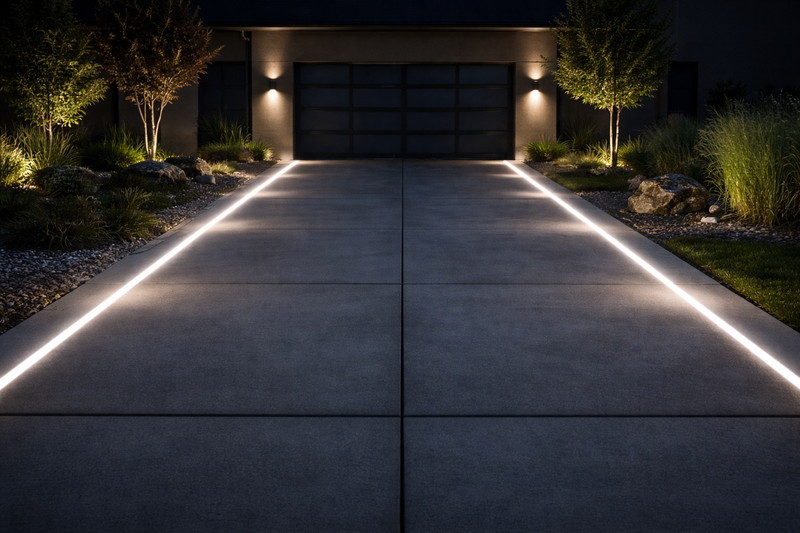
Which Lighting System Should You Buy for Each Zone?
A buyer asking only for “100 metres of waterproof LED strip” leaves the supplier to guess the mounting conditions. Identify the zone before comparing models or prices.
| Installation zone | Product direction | What to confirm before ordering |
|---|---|---|
| Protected walkway edge, planter or raised curb | An outdoor strip or neon assembly may be suitable when protected from feet, wheels and maintenance equipment. | Exact model, exposure rating, mounting profile, bend direction, cable exit and sealing details. |
| Recessed into a pedestrian path | Specify a complete ground-recessed luminaire intended for the pedestrian installation. | Declared loading conditions, cover temperature and surface suitability, mounting instructions, drainage and service access. |
| Crossing a driveway or wheel path | Specify an assembly explicitly supported for the intended vehicle loading. | Load evidence for the exact assembly and installation arrangement. A decorative channel or generic neon datasheet is insufficient. |
Procurement decision: if the design only needs a glowing boundary, moving the lighting into a protected raised edge may let you compare a different product family. Have the designer approve that location before requesting an alternative quote. Do not substitute an ordinary strip into a traffic-bearing slot to reduce the price.
What Evidence Supports a Drive-Over Claim?
Ask the fixture supplier to identify the tested model, cover, housing, mounting support and declared loading conditions. The evidence must describe the assembly you will install. A report for a different profile or a photograph of a tire above a light does not establish suitability.
IEC 62262 covers protection against external mechanical impacts, expressed by the IK code. An IK value therefore should not be converted into a vehicle-weight promise. For recessed applications, IEC 60598-2-13 specifically addresses ground-recessed luminaires; ask your supplier which applicable requirements and evidence their proposed assembly meets.
- Request the scope and model identification of the relevant test documentation.
- Put the expected traffic, vehicle crossings and mounting arrangement on the drawing sent for quotation.
- Ask whether the cover, seals and light source can be replaced without removing the surrounding paving.
- Have the responsible project designer or installer review the proposed installation before purchase.
RH’s strip and neon product pages are starting points for light-source selection. Their component specifications are not an approval for a complete drive-over installation. Include any traffic-bearing requirement in the first inquiry so the supply scope can be confirmed.
How Should Waterproofing and Drainage Be Specified?
Record what the installation will actually encounter: rain, standing water, irrigation, cleaning, freezing conditions or immersion. Ask for evidence covering the complete proposed configuration, including end caps, cable exits and connectors. A rating on an uncut sample does not automatically describe a field-cut or modified installation.
IEC 60529 defines the IP enclosure protection classification. Request the exact test conditions and the manufacturer’s permitted installation conditions rather than treating a larger IP number as permission for every wet location.
- Sealing: confirm who supplies and seals each termination, and what changes are permitted on site.
- Drainage: obtain the specified recess and drainage arrangement for the luminaire and site. Do not drill drainage holes through a sealed fixture unless its manufacturer expressly provides for them.
- Encapsulation: resin filling is a manufacturing design choice, not a field shortcut that automatically creates an IP rating. Confirm the tested materials, thermal design and repair method.
- Replacement: include spare end assemblies or replacement sections in the quote when required, and agree how they will match the original specification.
What Changes Between Concrete, Pavers and a Retrofit?
The civil work can cost more to redo than the light source. Send the mounting section to the supplier before the sample is approved, especially where the finished level or recess dimensions are already fixed.
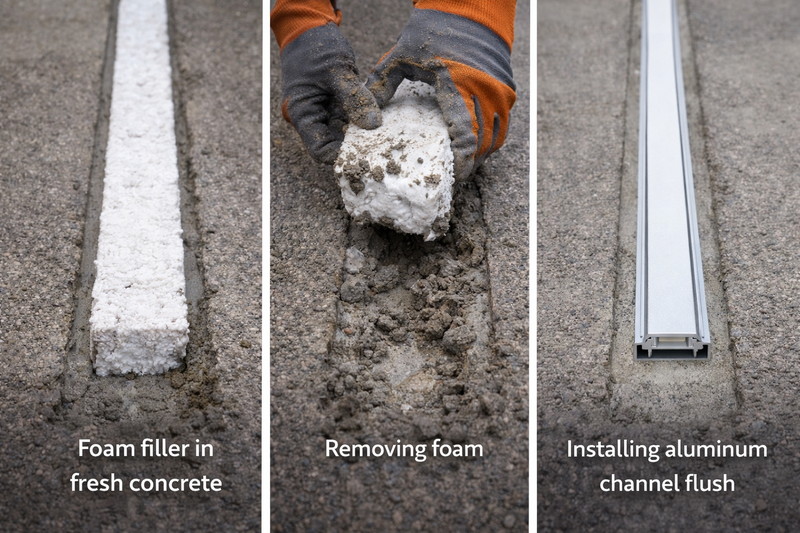
| Project condition | Information to include in the RFQ | Cost to separate in the proposal |
|---|---|---|
| New poured concrete | Proposed recess, finished level, support detail, cable entry and construction sequence. | Housing, mounting components and any civil-work allowance. |
| Pavers | Paver layout, base support, movement joints, drainage and access to cable connections. | End sections, joint details and replaceable assemblies. |
| Existing driveway or path | Available recess dimensions, existing services, access restrictions and areas that cannot be disturbed. | Retrofitting work separately from the lighting supply. |
A product quotation should make clear whether it includes only the lighting components or also profiles, connectors, drivers and mounting accessories. Site construction and electrical installation should have their own agreed scope.
How Do You Specify Power for a Long Outdoor Run?
Total metres and maximum uninterrupted run are different quantities. A project with 100 metres of lighting may consist of many separately powered sections. The permissible length depends on the selected model, its electrical design, wattage, conductor arrangement and the distance from the driver.
Do not accept a universal “48V means 100–200 feet from one feed” promise. Ask for a model-specific feed layout showing driver locations, lead lengths, cable sizing and the proposed operating conditions. Voltage alone also does not establish electrical safety or a power supply’s certification.
- Mark the longest section between power feeds as well as the total quantity.
- Include the distance from each proposed driver to the start of its light source.
- State the desired dimming/control method and any existing controller or driver.
- Request separate prices for the light source, power supplies, controls and connections where they are in scope.
For the layout information to send with a quotation request, see our outdoor run-length guide.
What Should a Project Sample Demonstrate?
Approve the proposed strip, diffuser and mounting arrangement together. A bare strip on a desk cannot show whether a finished path will have visible dots, uncomfortable brightness or a poor low-end dimming response.
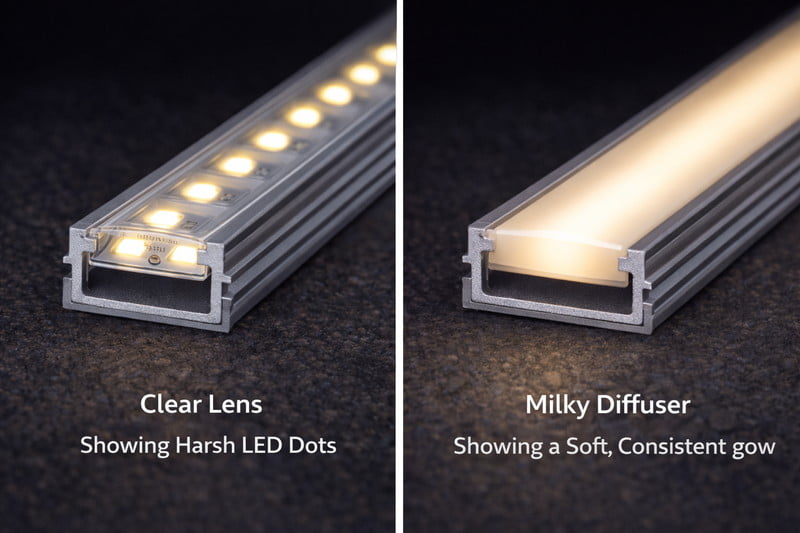
- Appearance: assess colour temperature, uniformity and brightness from the intended viewing positions.
- Fit: check the actual profile, bend direction, cable exit and available installation space.
- Control: test the selected driver and controller together across the required dimming range.
- Production reference: identify the approved model and configuration in the order. Agree what must be resubmitted if components change.
Ask for sample cost, shipping, preparation time and any credit-against-order terms in writing. Free samples or free freight should not be assumed.
Product Families to Review for Protected Outdoor Edges
These links help narrow the light-source choice. Confirm environmental ratings and the exact model for your project; they do not establish pedestrian or vehicle load suitability.
- Outdoor strip and neon lighting solutions — start with the location, exposure and system scope.
- Top-bend LED neon flex — compare the drawing and permitted bending direction with your route.
- Side-bend LED neon flex — review this family when its bend plane fits the design; confirm dimensions, radius and terminations.
Send This Brief for a Comparable Project Quotation
Copy the points below into the inquiry form. If a specification is undecided, say so and ask for a recommended option.
- Project and country: application, destination and required installation date.
- Position and traffic: raised/protected edge, pedestrian recess or vehicle crossing.
- Quantity: sample requirement, total metres, number of sections and longest section.
- Mechanical drawing: available width/depth, route, curves, cable exits and drainage.
- Lighting and power: white colour or colour-changing effect, dimming method, driver locations and lead distances.
- Supply scope: light source only, or a proposal including profiles, drivers, controls and connections.
- Commercial comparison: requested quantity tiers, sample charges, packing, freight basis, estimated lead time and warranty terms.
For a broader specification template, use our LED strip RFQ guide. Compare supplier offers against the same scope, not only a price per metre.
Request a Quote for Your Walkway or Landscape Project
Send your approximate metres, destination country, a brief description of the mounting location and the components you need. Include any pedestrian or vehicle loading requirement at the start. We will review the scope and confirm whether we can offer a suitable product configuration.
Ask for a sample proposal and the intended project quantity in the same inquiry. Minimum quantities, sample charges, lead time and product documentation depend on the confirmed specification.
Prefer email? Send your project brief to RH Strip Lighting.
Request a Project or Trade Quote
Sourcing for an installation project, resale or OEM production? Share your requirements below. You can discuss project samples before committing to a bulk order.
Related Articles
LED Strip Lighting for Indoor Plant Walls: Accent Light or Grow Light?
Specify LED lighting for indoor plant walls without confusing visual brightness with plant needs. Review PPFD, DLI, controls, moisture, and…
LED Strip Lighting After a Power Outage: Designing a Reliable Restart
Plan LED strip power restoration beyond total watts. Review driver inrush, switching limits, restart scenes, and commissioning before project handover.
Why LED Strip Lights Buzz When Dimmed: A Guide for Quiet Spaces
Diagnose LED strip buzzing without guessing. Review drivers, PWM controls, mounting resonance, and low-level acoustic acceptance for quiet interiors.