
RGB vs RGBW vs RGBWW LED Strips: Understanding the Differences and When to Use Each
Why the Wrong Color Type Is a Functional Problem, Not Just an Aesthetic One
RGB, RGBW, and RGBWW LED strips look nearly identical in a product catalog. They are sold at similar price points, they use the same PCB format, and they are often listed as equivalent options in lighting specification schedules. They are not equivalent. Specifying the wrong type does not produce a slightly inferior result—it produces an installation that is functionally inadequate for its intended use.
An RGB strip used as the primary white light source in a hospitality dining room will render skin tones and food poorly, making the space feel cold and clinical regardless of how warm the colour temperature appears on a kelvin scale. An RGBWW strip specified for a cool-toned commercial office will produce warm white light that conflicts with the design intent. A controller specified for RGB cannot drive an RGBW strip correctly. These are specification errors with measurable consequences for occupant experience and client satisfaction.
This article explains the fundamental differences between the three formats, how those differences manifest in photometric performance, and precisely when each is the correct specification.
RGB: Pure Color Mixing, Compromised White
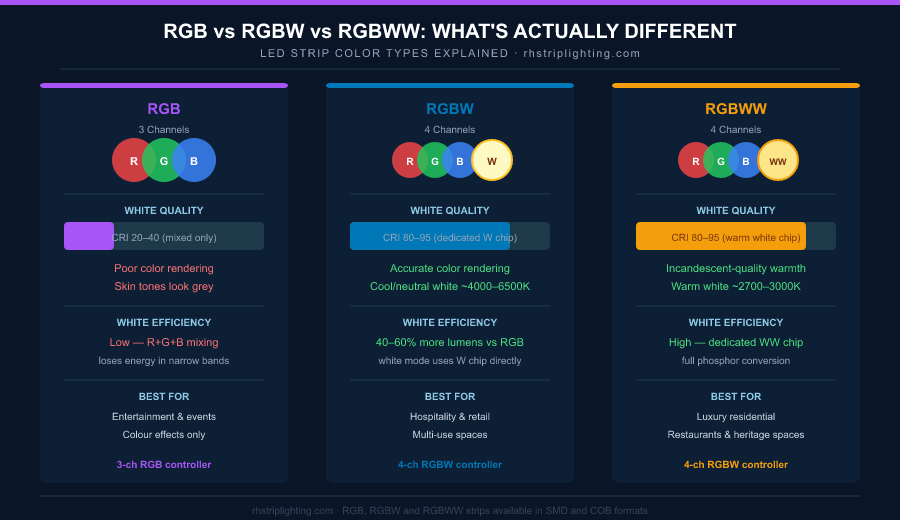
RGB strips contain three semiconductor chips per node: a red-emitting, a green-emitting, and a blue-emitting chip. By independently varying the drive current to each chip, any colour within the gamut defined by the three primaries can be produced. At full drive on all three channels simultaneously, the combined output appears white to the human eye—but it is a metameric white, not a spectrally complete white.
Why RGB White Is Spectrally Incomplete
True white light—sunlight, incandescent light, or phosphor-converted LED white light—contains spectral energy distributed continuously across the visible spectrum. RGB “white” contains energy only in three narrow bands: the emission peaks of the red, green, and blue chips, with large spectral gaps between them.
The consequence is a CRI (Color Rendering Index) of typically 20–40 for RGB-mixed white. Objects whose reflectance peaks fall in the spectral gaps appear shifted, muted, or distorted in colour. The most visually important gap is in the deep red (620–700 nm): the R9 component, which governs how skin tones, food, fabric, and warm-coloured materials are rendered. RGB mixed white renders all of these poorly.1
The Efficiency Penalty of RGB White
Beyond colour quality, RGB white is energy-inefficient. Each chip converts electricity primarily to photons in its own spectral band, with the remainder dissipated as heat. When mixing RGB to produce white, you are running three narrowband emitters at partial efficiency and discarding the spectral energy that falls outside the narrow human-perceived-as-white combination. A dedicated phosphor-converted white chip converts nearly all of its electrical input into useful visible light across the full spectrum.
Insight: The 40–60% luminous flux penalty of RGB white. When an RGBW strip produces white using the dedicated W chip, it delivers 40–60% more lumens than the same strip mixing RGB channels to approximate the same apparent colour temperature. The reason is that each individual R, G, and B chip operates at lower photon extraction efficiency than a broadband phosphor chip, and the three narrow spectral bands combined still represent only a fraction of the visible spectrum’s energy distribution. This means RGBW is not just better at colour quality in white mode—it consumes significantly less energy to produce the same luminous flux in white. In any installation where white mode will be used for more than a minority of operating hours, RGBW’s energy efficiency advantage alone is sufficient to justify its cost premium.2
When RGB Is the Correct Specification
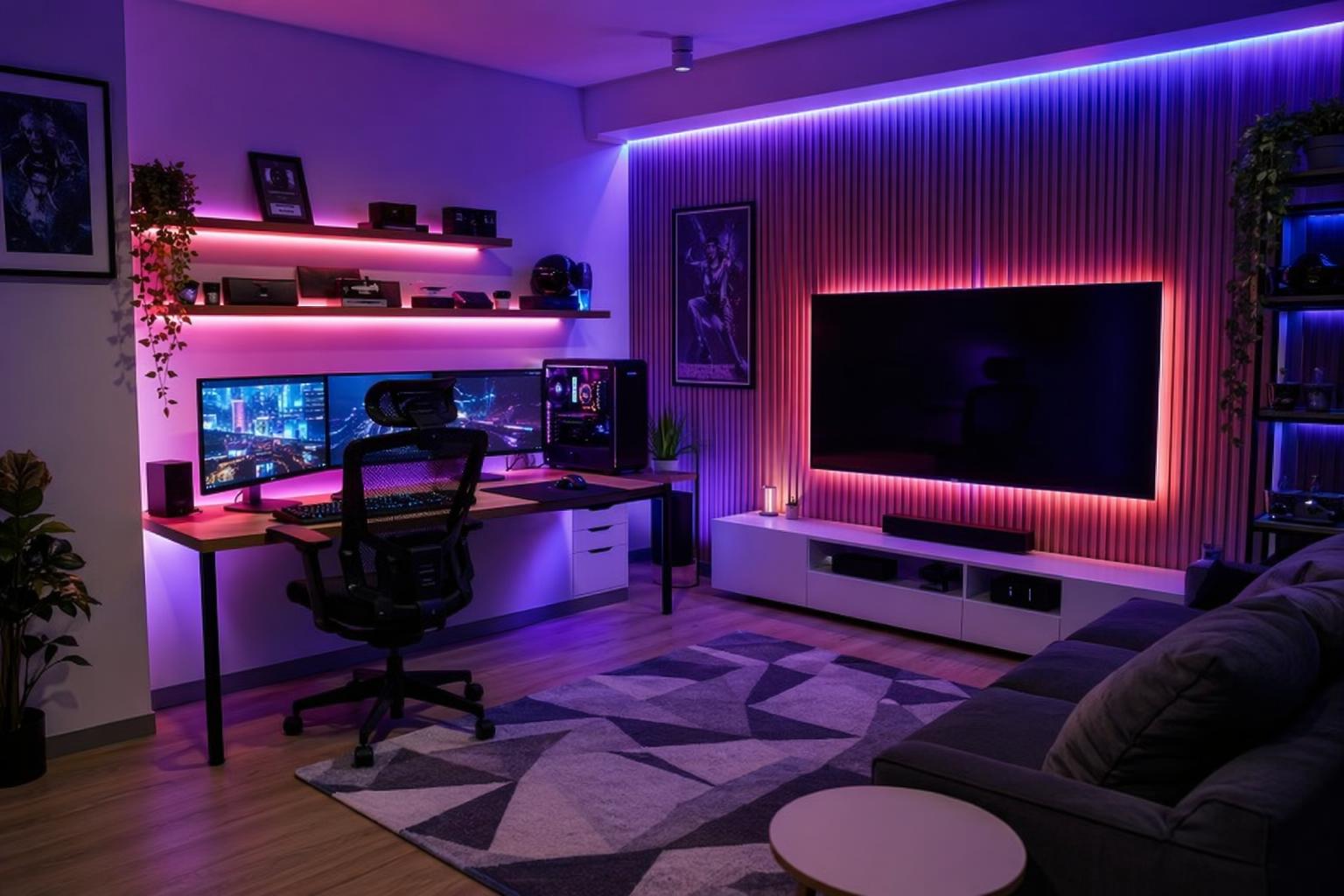
- Entertainment venues, gaming rooms, and event spaces where saturated colour effects are the primary function and white quality is not required
- Architectural colour wash on non-occupied surfaces—concrete, stone, exterior facades—where the visual experience is about colour, not object rendering
- Stage and theatrical lighting where specific saturated hues are the design intent
- Signage and display backlighting where colour gamut, not white accuracy, is the driver
- Any application where the strip will operate in colour mode 90%+ of the time and white mode is rarely or never used
View our Indoor RGB/RGBW SMD LED Strip options with detailed colour gamut specifications.
RGBW: The Dual-Function Professional Choice
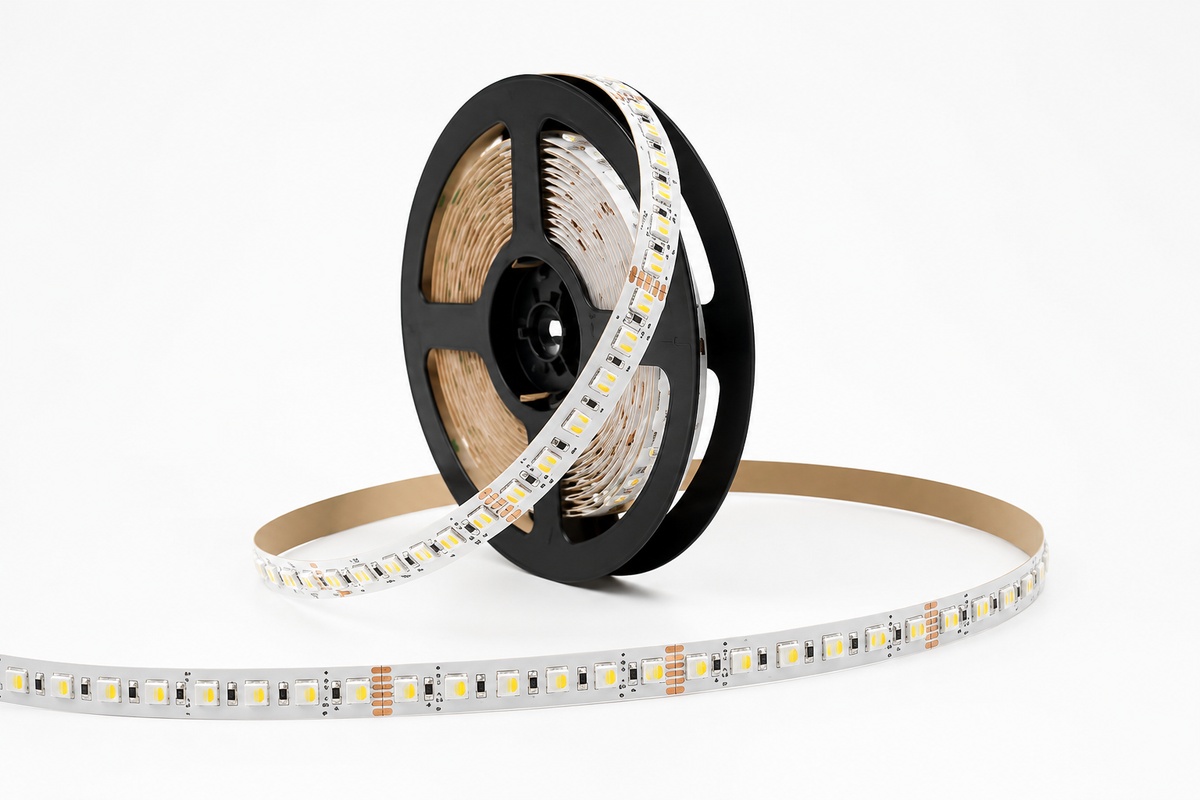
RGBW strips add a fourth dedicated White chip to the standard RGB cluster. This white emitter is a phosphor-converted chip—identical in construction to the white LEDs used in high-quality single-colour LED strips—with CRI typically 80–95 depending on specification.
The architectural significance is this: the W channel is completely independent of the RGB channels. When white illumination is required, the W chip is driven directly, with CRI accuracy and spectral completeness indistinguishable from a dedicated white strip. When colour effects are required, the RGB channels are used—either alone or blended with the W channel for pastel and mixed-tone effects.
The Dual-Function Capability
RGBW’s defining capability is its ability to function simultaneously as:
- A high-quality white light source (using the W chip) for ambient and task illumination
- A full-colour decorative source (using RGB channels) for accent and mood lighting
- A mixed-colour source (RGB + W simultaneously) for subtle pastel tones, skin-flattering warm blends, or colour-corrected whites
This flexibility makes RGBW the correct choice for multi-use spaces where lighting modes change throughout the day or across events. A conference room that operates in white mode for presentations and shifts to colour mode for evening events does not need two separate lighting systems—one RGBW installation handles both modes with a single control system.
When RGBW Is the Correct Specification
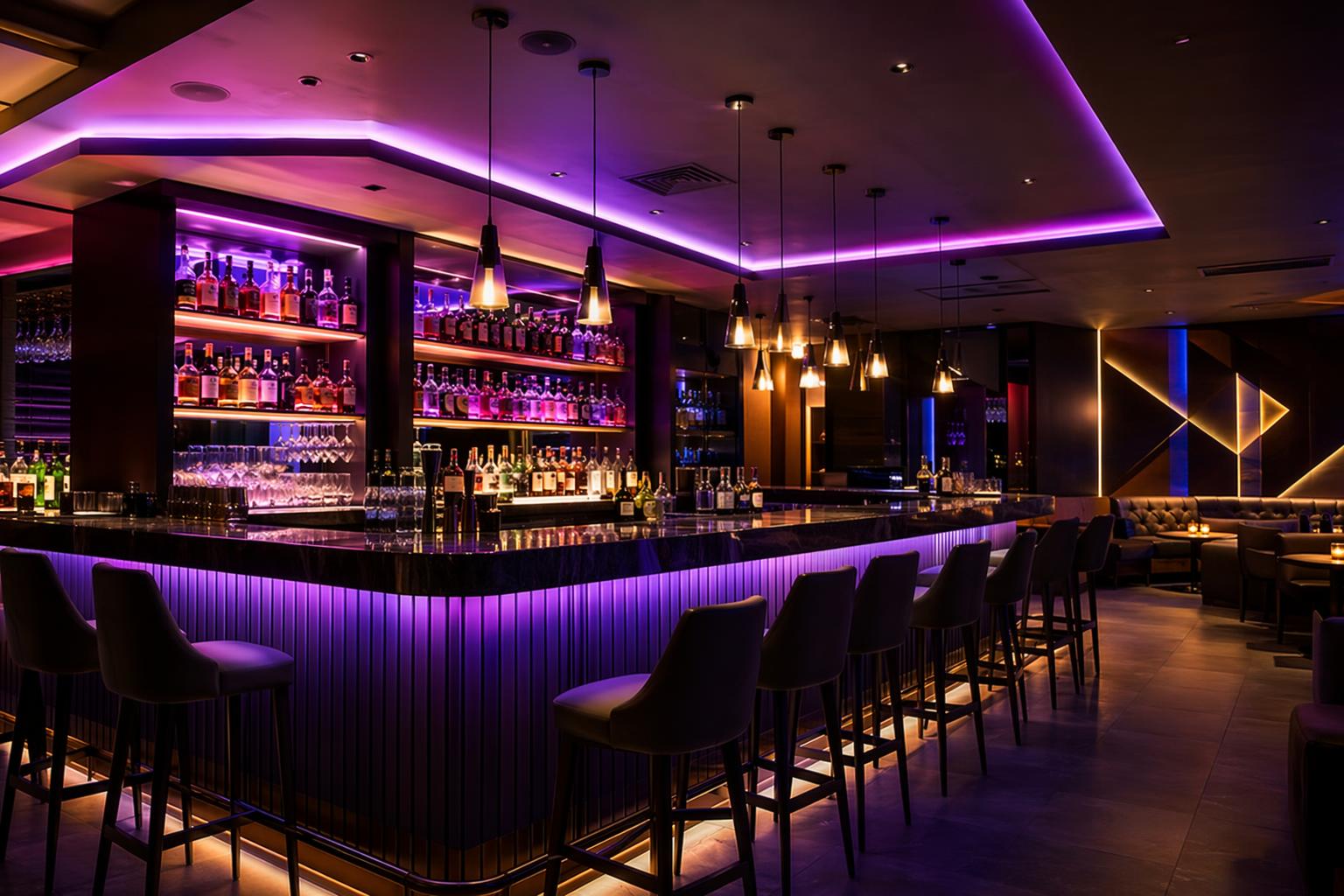
- Hospitality spaces—hotel lobbies, restaurants, bars—where clean white ambient illumination is the primary function but colour accent capability is required for atmosphere variation
- Premium retail environments where product rendering accuracy in white mode is essential but dynamic colour for seasonal displays or events is also needed
- Residential installations where the same strip serves as living room ambient lighting and mood lighting, requiring both high CRI white and colour capability
- Multi-use commercial spaces—conference rooms, event halls, exhibition spaces—where lighting scenarios vary significantly across uses
- Any specification where the client wants “colour capability” but the space is primarily occupied under white light conditions
Our Multicolor COB LED Strip offers RGBW performance with COB uniformity for premium applications where both colour quality and visual uniformity are required.
RGBWW: Incandescent-Quality Warmth with Colour
RGBWW strips replace the cool or neutral white chip present in RGBW with a Warm White chip, typically rated at 2700K–3000K. This is not simply a different CCT option—it represents a fundamentally different design philosophy targeting environments where the quality and character of white light at incandescent colour temperatures is non-negotiable.
The warm white chip in RGBWW strips uses a phosphor formulation with higher red-channel content, delivering the amber-rich spectral distribution associated with incandescent and halogen sources. When experienced by occupants, this produces the perceptual qualities of warmth, intimacy, and flattery associated with candlelight and incandescent dining—qualities that cannot be replicated by mixing RGB channels regardless of how warm the apparent colour temperature appears.
RGBWW and Tunable White Capability
By mixing the warm white chip with the blue and green channels, RGBWW strips can approximate a tunable white range from approximately 2700K to 4500K—though not with the tight delta-uv control of a dedicated dual-white (WW+CW) tunable white strip. For applications requiring precise CCT tuning across a wide range with clinical accuracy, a dedicated tunable white strip is the better specification. For applications where warm CCT is the design standard and some tuning capability is desired as a secondary feature, RGBWW is appropriate.
When RGBWW Is the Correct Specification
- High-end residential where the baseline expectation is incandescent-equivalent white light quality
- Luxury dining and hospitality where warm ambiance is a brand and experience requirement, and cool white would be architecturally inappropriate
- Heritage properties, museums with warm-material collections, and environments where period lighting character is part of the design brief
- Any project where the designer has explicitly called for warm white (<3000K) as the only white mode, with colour capability for accent use
Controller Compatibility: The Most Common Ordering Error
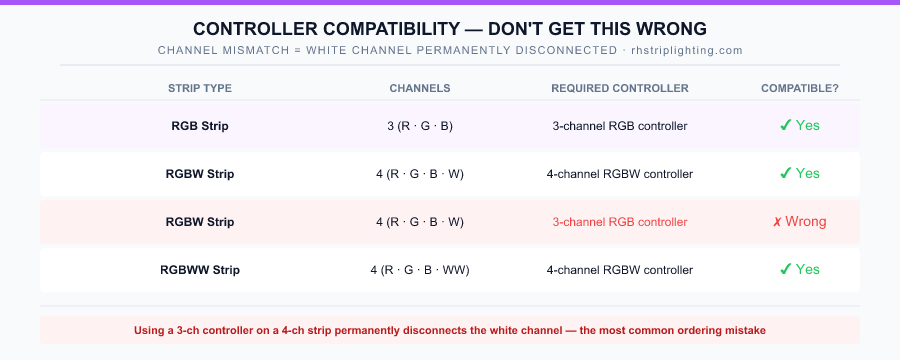
Channel mismatch between strip and controller is the single most common procurement error in colour LED strip specification, and it is entirely avoidable.
- RGB strips require 3-channel controllers
- RGBW strips require 4-channel RGBW controllers
- RGBWW strips require 4-channel RGBW controllers (the WW chip maps to the W channel)
Using a 3-channel RGB controller to drive an RGBW strip permanently disconnects the white channel. The strip will function in colour mode but the W chip—the component that delivers CRI-accurate white light—will never be energised. The installation delivers RGB performance at RGBW cost, and the only remedy is controller replacement.3
For DMX-controlled installations, verify that each decoder or driver supports the correct channel count per zone before procurement. A 4-universe DMX system providing 3 channels per pixel to RGBW strips will produce the same connectivity failure as an analogue RGB controller.
For addressable applications with per-pixel control, see our Addressable SMD LED Strip range with SPI protocol compatibility.
Five-Channel RGBCW+WW: The Advanced Option
A growing product category adds both Cool White and Warm White channels alongside RGB, creating 5-channel strips (R + G + B + CW + WW). This allows both full-spectrum tunable white (from 2700K to 6500K with proper CCT control) and full RGB colour capability from a single strip type. Applications include circadian rhythm lighting systems in healthcare and workplace environments, and dynamic facade lighting requiring both white and colour modes with high colour accuracy in white.
Five-channel strips require 5-channel decoders and controllers, and are not yet widely available across the market. For most commercial applications, a 4-channel RGBW or RGBWW strip combined with a dedicated tunable white strip in separate zones remains a more cost-effective and controllable solution.
FAQ
Can I use RGBW in a space that only ever uses white mode?
Yes, and it is sometimes the right choice. If there is any possibility that the client will want colour capability in future, RGBW installed now with a 3-channel controller (leaving the W channel connected to a separate dimmer) future-proofs the installation without full 4-channel control costs. Retrofitting colour capability to an existing white installation requires full strip replacement.
Why does my RGB white look different from my RGBW white even when both are set to “warm white”?
Because they are producing fundamentally different spectra. RGB warm white is three narrow peaks whose combined appearance approximates a warm temperature to the eye, but with low CRI. RGBW warm white (if the W chip is a neutral or warm chip) is a broad continuous spectrum with high CRI. Objects—especially skin tones—will look noticeably different under each, even at the same apparent colour temperature.
Can RGBW and RGBWW strips be mixed in the same installation?
They can be on separate circuits, but they cannot be matched to appear identical in white mode: RGBW produces cool to neutral white (from the W chip) and RGBWW produces warm white (from the WW chip). Using both in the same continuous visual field will create a visible colour temperature discontinuity at the zone boundary.
Recommended Products
Colour LED Strip Selection Guide
| Your Need | Recommended Product |
|---|---|
| Colour effects only, no white quality needed | RGB SMD LED Strip |
| Colour + quality white (cool/neutral) | RGBW SMD LED Strip |
| Colour + incandescent-quality warm white | RGBWW SMD LED Strip |
| Colour + white with COB uniformity | Multicolor COB LED Strip |
| Per-pixel addressable effects | Addressable SMD LED Strip |
Unsure which type matches your project? Contact our technical team with your application details and we will recommend the right specification.
References
- CIE 13.3, Method of Measuring and Specifying Colour Rendering Properties of Light Sources, including discussion of R1–R8 and extended colour samples R9–R15. ↩
- U.S. Department of Energy, Color Quality of LED Lamps, Solid-State Lighting Program; spectral power distribution analysis of RGB-mixed vs phosphor-converted white. ↩
- ANSI E1.11 (DMX512-A standard), ESTA Technical Standards Program, channel assignment requirements for multi-channel LED control systems. See ESTA TSP. ↩
Request a Project or Trade Quote
Sourcing for an installation project, resale or OEM production? Share your requirements below. You can discuss project samples before committing to a bulk order.
Related Articles

LED Strip Lighting for Indoor Plant Walls: Accent Light or Grow Light?
Specify LED lighting for indoor plant walls without confusing visual brightness with plant needs. Review PPFD, DLI, controls, moisture, and…

LED Strip Lighting After a Power Outage: Designing a Reliable Restart
Plan LED strip power restoration beyond total watts. Review driver inrush, switching limits, restart scenes, and commissioning before project handover.

Why LED Strip Lights Buzz When Dimmed: A Guide for Quiet Spaces
Diagnose LED strip buzzing without guessing. Review drivers, PWM controls, mounting resonance, and low-level acoustic acceptance for quiet interiors.