
Tunable White LED Strips: The Complete Specification Guide for Architects and Lighting Designers
Walk into any high-end hotel lobby today, and you’re likely to experience the same light at 9 a.m. that you do at 9 p.m. — except you probably shouldn’t. A lobby meant to energize morning arrivals and wind down evening guests is failing at both jobs if it runs on a fixed 3000K LED strip from open to close. Tunable white LED strips solve this problem. But specifying them correctly requires understanding a surprisingly nuanced set of electrical, photometric, and control-system variables that most supplier datasheets quietly omit.
This guide covers everything a lighting designer, contractor, or facility manager needs to know before ordering tunable white strips — from color temperature range and CRI consistency across the scale, to dual-channel wiring architecture, driver compatibility, and the building standards that now mandate dynamic CCT control in healthcare and education.
What Tunable White Actually Means — and What It Doesn’t
A tunable white LED strip contains two separate rows of LEDs on a single PCB: one row of warm white chips (typically 2700K or 3000K) and one row of cool white chips (typically 5000K or 6500K). By independently dimming each channel, the controller shifts the apparent mixed CCT anywhere within that range. The strip itself does not change color — it blends two fixed-CCT sources.
Insight: The “tunable range” is not continuous in the scientific sense — it is a mix ratio between two endpoints. A strip rated “2700K–6500K tunable” cannot actually produce true 6500K light; it can produce the appearance of ~6500K by running the cool channel at 100% and dimming the warm to near-zero. This means the spectral power distribution at each CCT point is an overlay of two chip spectra, not a native single-chip emission. The CRI and R-value performance at intermediate CCT points reflects this blending.
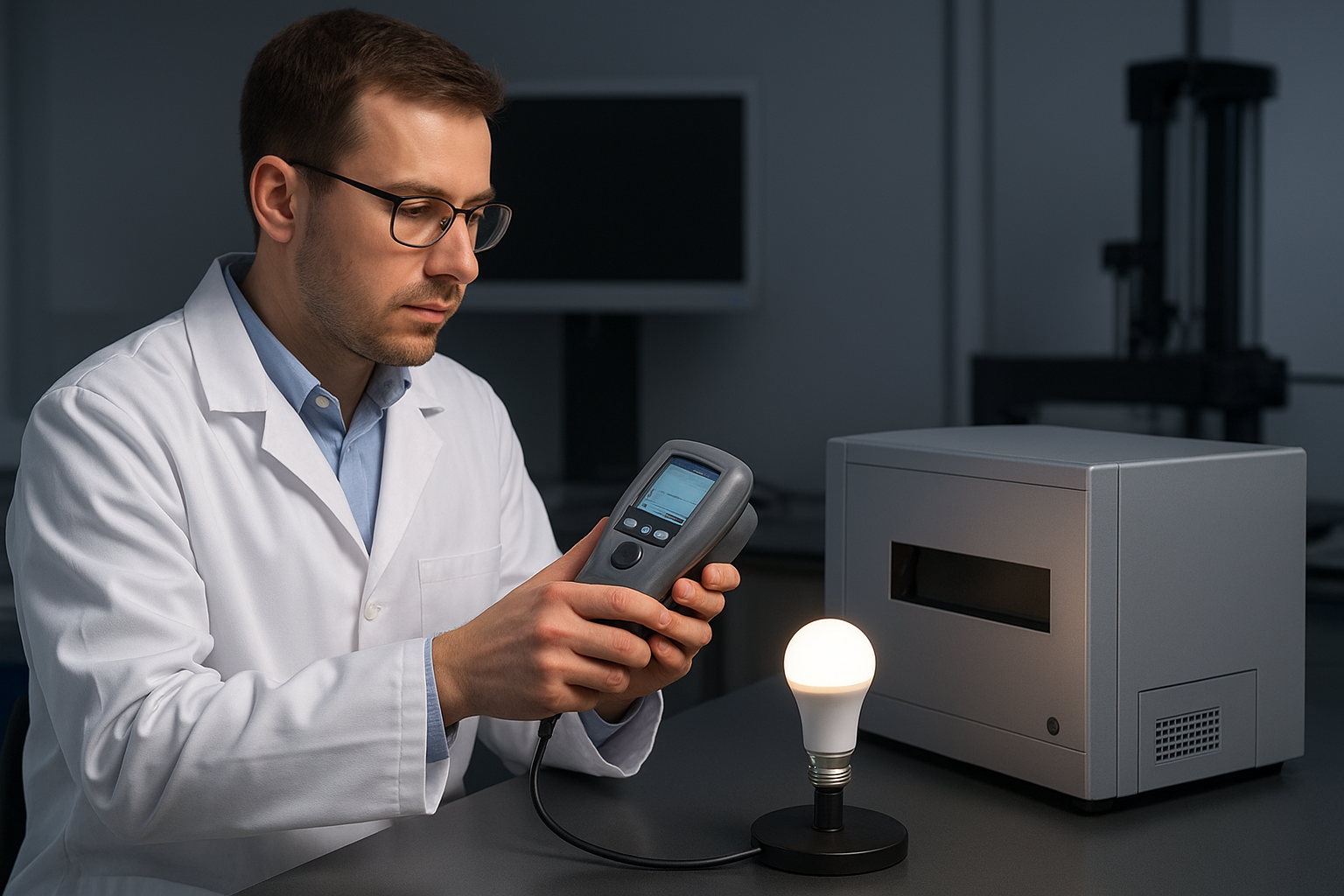
This has a critical implication: CRI consistency across the tuning range varies with the LEDs selected. A tunable white strip using high-quality chips might show CRI 95+ at 2700K but only CRI 88 at 5000K, or vice versa. Always request spectroradiometer data at multiple points across the CCT range — at minimum, at the two endpoints and at the center (typically 3500K or 4000K). Suppliers who can only provide data at a single CCT are unlikely to be using matched, binned chip pairs.
The Two Wiring Architectures: 4-Wire vs 5-Wire
Tunable white strips come in two electrical configurations, and mixing them with the wrong driver is a common specification error.
4-wire system (shared V+ common): The most common configuration. V+ is shared between both channels; each channel has its own negative return (WW– and CW–). The driver supplies a single DC voltage rail and switches the two negative lines independently using two PWM channels. Suitable for 24V systems with lengths up to 5–6 meters per run before voltage drop becomes an issue.
5-wire system (independent channels): Each warm and cool channel has both a positive and negative wire. Less common, used in high-power applications and some DALI-2 DT8 systems where each channel is fully isolated. More complex to wire but allows tighter current control over longer runs.
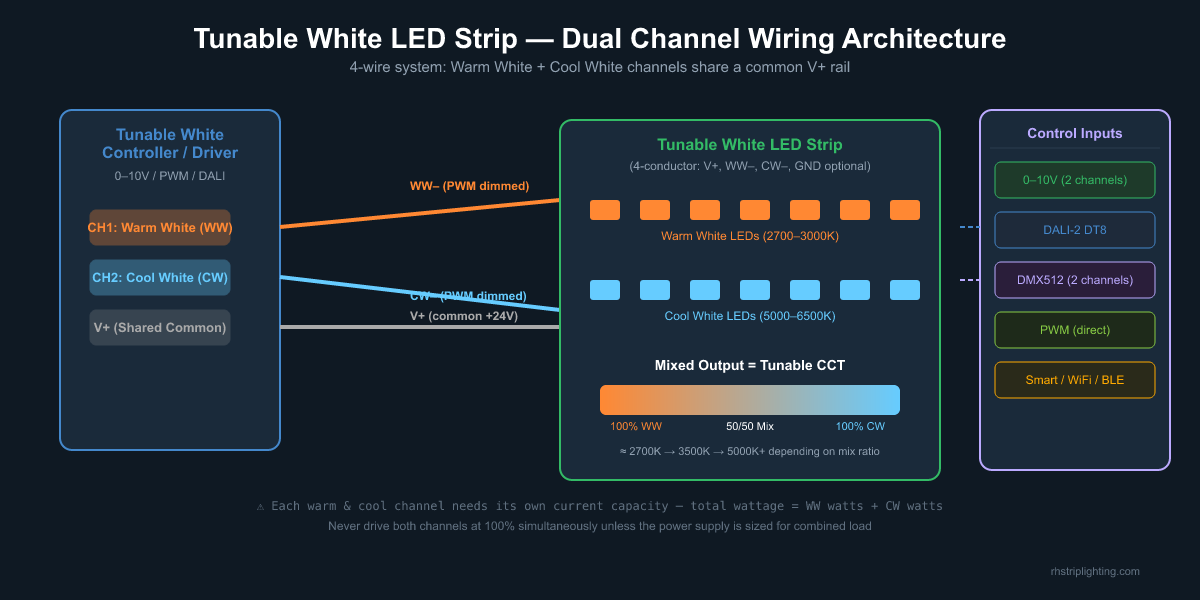
The single most common error in tunable white installations is connecting a 4-wire strip to a standard single-channel dimmer. The strip will work, but only one CCT is accessible — the opposite channel is either always on or always off. Always verify that your driver or controller explicitly supports “dual-channel tunable white” or “CCT + DIM” operation, not just dimming.
Power Supply Sizing: The 80% Rule and Simultaneous Load
Tunable white strips require careful power supply sizing. The total wattage equals the warm channel wattage plus the cool channel wattage — not the maximum of one channel. A 14W/m tunable white strip (7W warm + 7W cool) running at 50% warm and 50% cool draws approximately 7W/m total at that mix point, but must be sized for the full 14W/m in case both channels are demanded simultaneously during a scene transition.
The standard industry rule is to size power supplies at no more than 80% of their rated capacity. For a 5-meter tunable white run drawing 14W/m at max: 5m × 14W = 70W, divided by 0.8 = 87.5W minimum PSU. Round up to 100W.[1]
Insight: During a CCT transition (e.g., fading from 2700K to 5000K), both channels are simultaneously active at partial output. The instantaneous draw briefly spikes before the warm channel fades. If your PSU is sized only for one channel’s peak, this transition will trigger thermal protection shutdown — causing a brief blackout during every scene change. This failure mode is almost never documented in supplier troubleshooting guides.
Control Protocols for Tunable White
The control interface determines how precisely you can manage the CCT-to-dim relationship — and whether the system can execute circadian schedules automatically.
0–10V (two-channel): Two separate 0–10V signals, one for warm and one for cool. Simple and inexpensive, but requires the operator or automation system to correctly coordinate both signals to maintain the intended CCT at any dim level. Incorrect coordination causes “color drift on dim” — the light shifts CCT as brightness changes.
DALI-2 DT8: DALI Device Type 8 is specifically designed for color control, including tunable white (Tc mode). DT8 allows a single DALI address to control both channels simultaneously, with the CCT and intensity independently addressable. This eliminates color drift on dim and enables scene recall, group addressing, and emergency mode. For healthcare and education projects, DALI-2 DT8 is rapidly becoming the standard.[2]
DMX512 / Art-Net: Industry standard for theatrical and hospitality applications. Two DMX channels per zone (one per LED channel), allowing highly granular scene programming. Requires a DMX controller or gateway; typically not appropriate for office or healthcare environments where simplicity matters.
Proprietary Smart Systems (WiFi/Zigbee/BLE): Consumer-grade solutions including Tuya, Philips Hue compatible, and similar ecosystems. Effective for residential and simple commercial applications. Not recommended for commercial projects requiring third-party commissioning, emergency lighting integration, or future-proof interoperability.

Circadian Lighting and the WELL Building Standard
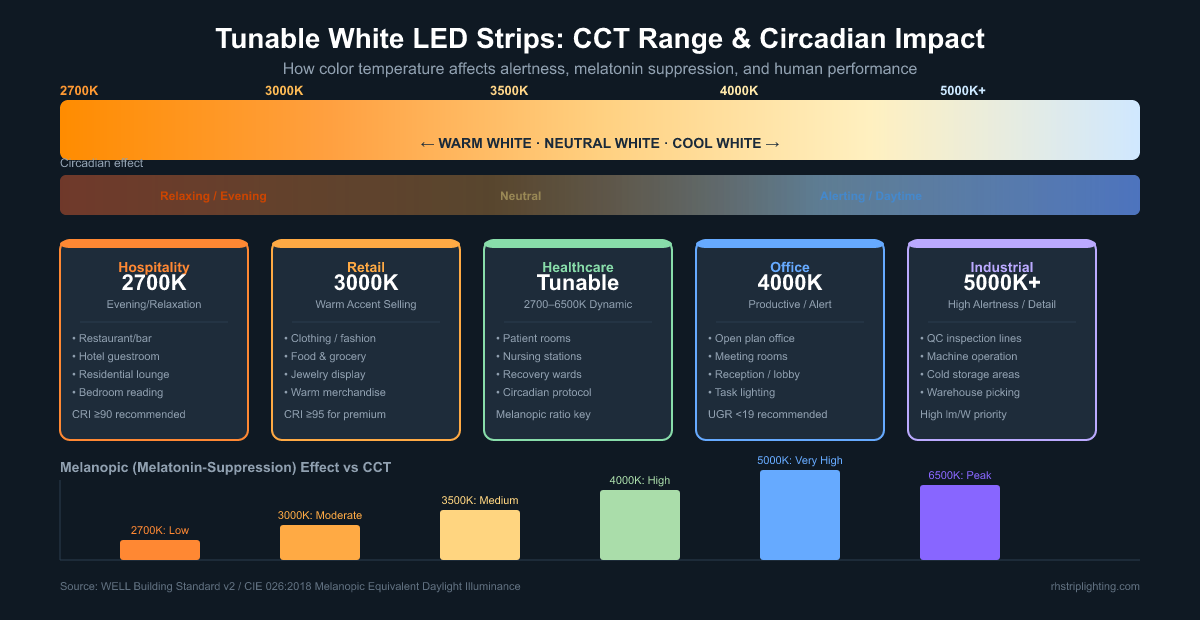
The scientific basis for tunable white in healthcare and commercial settings is the discovery that short-wavelength (blue-spectrum) light suppresses melatonin production and advances circadian phase — in plain terms, cool light promotes alertness and delays sleep onset, while warm light has minimal circadian impact. This effect is quantified by the melanopic equivalent daylight illuminance (MEDI), defined in CIE 026:2018.[3]
The WELL Building Standard v2 (Feature L07) specifies minimum MEDI thresholds at the eye level for different applications. For office environments, WELL requires ≥250 lux MEDI at a height of 1.2m during core working hours — a target that typically cannot be met with warm 2700K lighting alone at standard office illuminance levels. Tunable white strips, when programmed to shift toward 5000K+ during peak working hours, are one of the primary compliance strategies.
Insight: CCT alone does not determine the circadian effect — the illuminance level and spatial distribution matter equally. A 5000K strip at 50 lux has less melanopic impact than a 3000K strip at 500 lux. Specifying a tunable white system for WELL compliance requires a full MEDI calculation using the room’s photometry, not just a CCT target.
Hospitality: The Most Common Tunable White Application
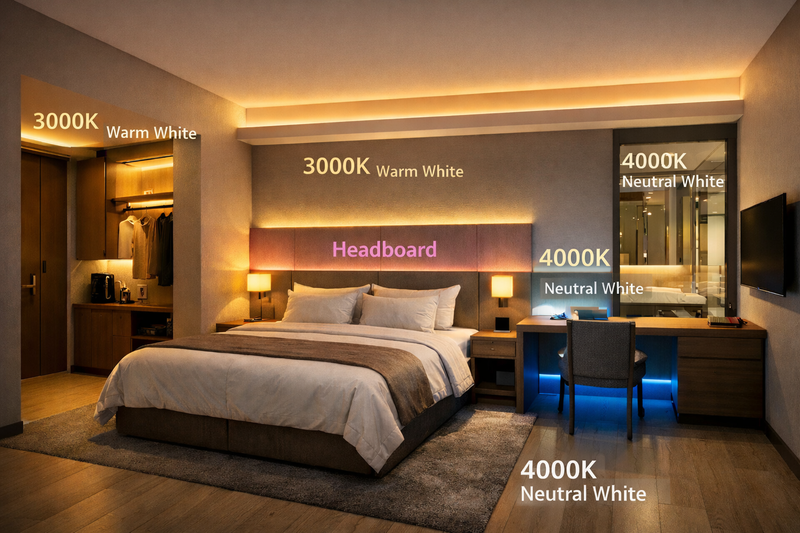
Hotel guestrooms represent the highest-volume market for tunable white strips. The design objective is simple: provide warm, relaxing light for evening use and a slightly brighter, cooler option for morning grooming and reading. The typical specification for a 4- or 5-star guestroom is:
- CCT range: 2700K–4000K (cooler than 4000K is rarely needed in guestrooms)
- CRI: ≥90 across the full range, with R9 ≥50
- Dimming: smooth, flicker-free (IEEE PAR 1789-2015 low-risk threshold: ≥1600 Hz PWM)
- Control: BMS-integrated or in-room panel with preset scenes (Wake, Relax, Sleep, Reading)
- Maximum wattage: 8–14W/m depending on cove depth and target illuminance
Key Specification Checklist Before You Order
- CCT endpoints and step count: What are the warm and cool chip CCTs? Can you provide spectroradiometer SPD data at both endpoints and at the midpoint?
- CRI across the range: CRI, R9, and R13 at 2700K, midpoint, and the cool endpoint — not just at one CCT.
- Wiring configuration: 4-wire or 5-wire? What is the pinout (V+, WW–, CW–)?
- Current per channel: What is the max current draw per channel at full output? Required to size drivers correctly.
- PWM frequency: What frequency does the driver operate at? Must exceed 1600 Hz for flicker-safe operation.
- Minimum dim level: What is the minimum stable CCT and dim level before the strip flickers or extinguishes?
- Driver compatibility list: Which specific drivers or controller models has the supplier tested and validated?
Frequently Asked Questions
Can I use a standard dimmable driver with a tunable white strip?
No. A standard single-channel dimmable driver connects to one LED polarity. A tunable white strip has two independently switched channels. You need a dual-channel driver specifically designed for tunable white (CCT control), not a standard dimming driver.
Does “tunable white” include RGB colors?
No. Tunable white produces only white light in varying color temperatures. For color-changing applications, you need RGB, RGBW, or RGBWW strips. Some RGBW strips can approximate tunable white behavior, but with less CCT precision and typically lower CRI.
Why does the color temperature drift when I dim a tunable white strip?
This is “color shift on dim” and results from one channel dimming at a slightly different rate than the other. It can be caused by mismatched PWM frequency between channels, driver tolerances, or incorrect 0–10V signal calibration. A DALI-2 DT8 driver handles both channels as a single coordinated system and eliminates this problem.
What minimum CRI should I specify for a tunable white strip?
For commercial and hospitality applications, specify CRI ≥90 with R9 ≥50. For retail or museum applications, CRI ≥95 with R9 ≥80 is appropriate. Always request data at both the warm and cool endpoints — CRI often varies by 5–8 points across the range.
Is tunable white the same as human-centric lighting?
Tunable white is a tool used in human-centric lighting systems, but the terms are not interchangeable. Human-centric lighting (HCL) is a design philosophy targeting physiological and psychological wellbeing. It incorporates CCT control, illuminance scheduling, circadian phase alignment, and sometimes spatial distribution. A tunable white strip is a hardware component; HCL is the system-level outcome.
Recommended Products
For tunable white installations, we supply high-CRI dual-channel LED strips with matched warm/cool chip pairs, DALI-2 compatible drivers, and aluminum profiles for clean linear installations:
- SMD Tunable White LED Strip Light — 2700K–6500K dual-channel, CRI 90+, 24V, available in 5/10/15W per meter
- COB Tunable White LED Strip Light — dot-free uniform glow, 2700K–6500K, ideal for cove and hospitality
- Single Color SMD LED Strip Light — fixed CCT (2700K/3000K/4000K/5000K/6500K) for non-dynamic applications
Footnotes
- NFPA 70 (National Electrical Code) and IEC 60364-5-52 both recommend derating continuous loads to 80% of conductor and device capacity. The same principle applies to LED driver sizing to prevent thermal premature failure. NFPA 70 §210.19
- DALI-2 (IEC 62386) Device Type 8 (DT8) defines color control commands including Tc (tunable white), XY (CIE chromaticity), RGBWAF, and primary N. See the DALI Alliance technical overview: DALI-Alliance DT8
- CIE 026:2018 defines the α-opic quantities including the melanopic action spectrum and MEDI calculation methodology. The WELL Building Standard v2 Feature L07 references these metrics for circadian lighting compliance. CIE S 026/E:2018
Request a Project or Trade Quote
Sourcing for an installation project, resale or OEM production? Share your requirements below. You can discuss project samples before committing to a bulk order.
Related Articles
LED Strip Lighting for Indoor Plant Walls: Accent Light or Grow Light?
Specify LED lighting for indoor plant walls without confusing visual brightness with plant needs. Review PPFD, DLI, controls, moisture, and…
LED Strip Lighting After a Power Outage: Designing a Reliable Restart
Plan LED strip power restoration beyond total watts. Review driver inrush, switching limits, restart scenes, and commissioning before project handover.
Why LED Strip Lights Buzz When Dimmed: A Guide for Quiet Spaces
Diagnose LED strip buzzing without guessing. Review drivers, PWM controls, mounting resonance, and low-level acoustic acceptance for quiet interiors.