
LED Strip Lighting for Refrigerated Display Cases and Cold Rooms
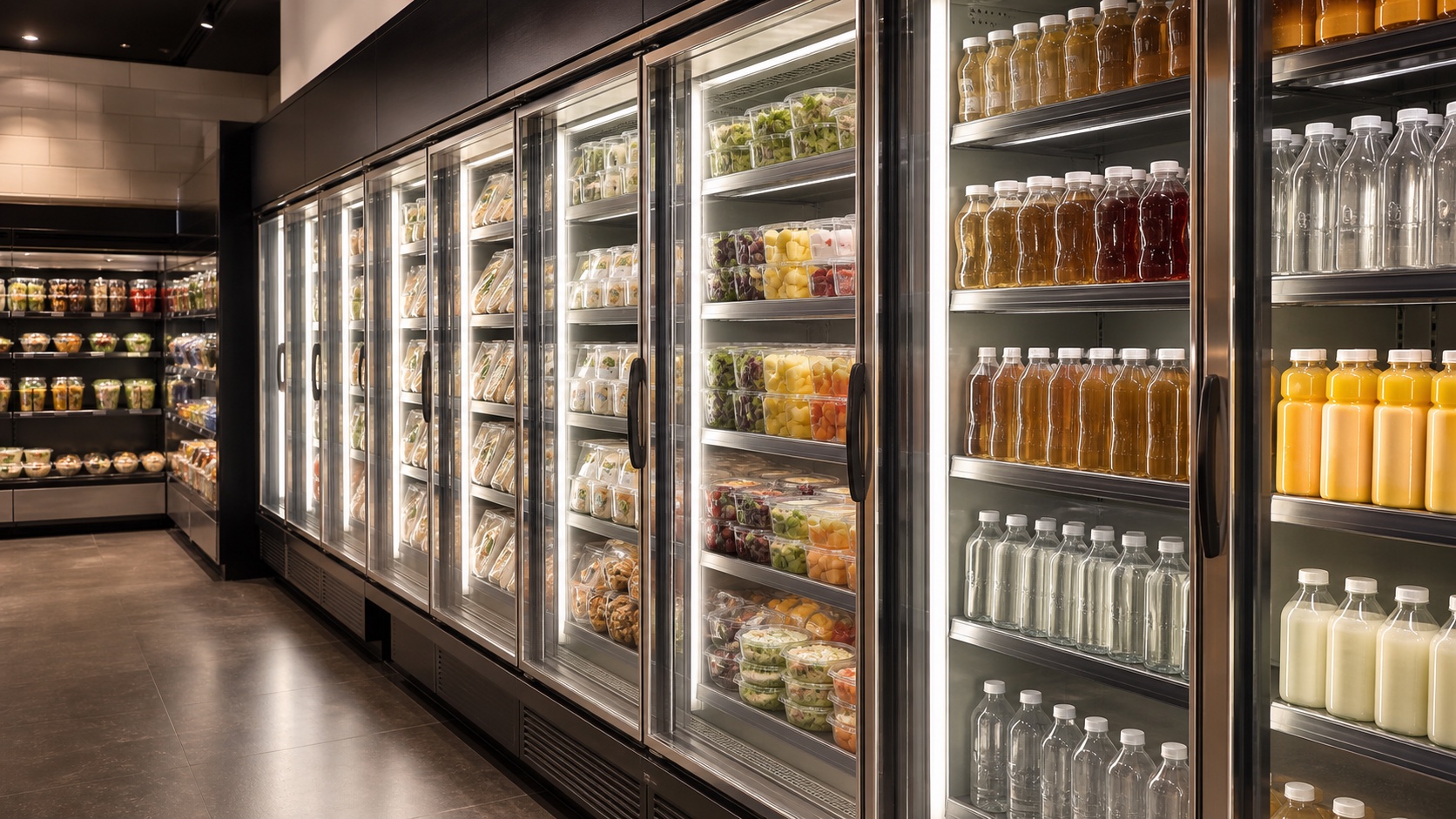
LED strip lighting inside a refrigerated display case looks like a simple linear-lighting application. It is not. The strip has to render products accurately, remain visually uniform at close range, survive cold operation and warm transitions, avoid glare in glass doors, tolerate cleaning, and remain serviceable without compromising the refrigerator.
The most important design decision is therefore not “COB or SMD?” and it is not “IP65 or IP67?” The real decision is how the complete lighting system will behave through pull-down, steady cooling, door opening, defrost, cleaning, and restart. A strip can work perfectly on a bench and still fail after it is installed in a case because the weakest point is often the cut end, connector, cable penetration, adhesive, driver, or trapped moisture—not the LEDs.
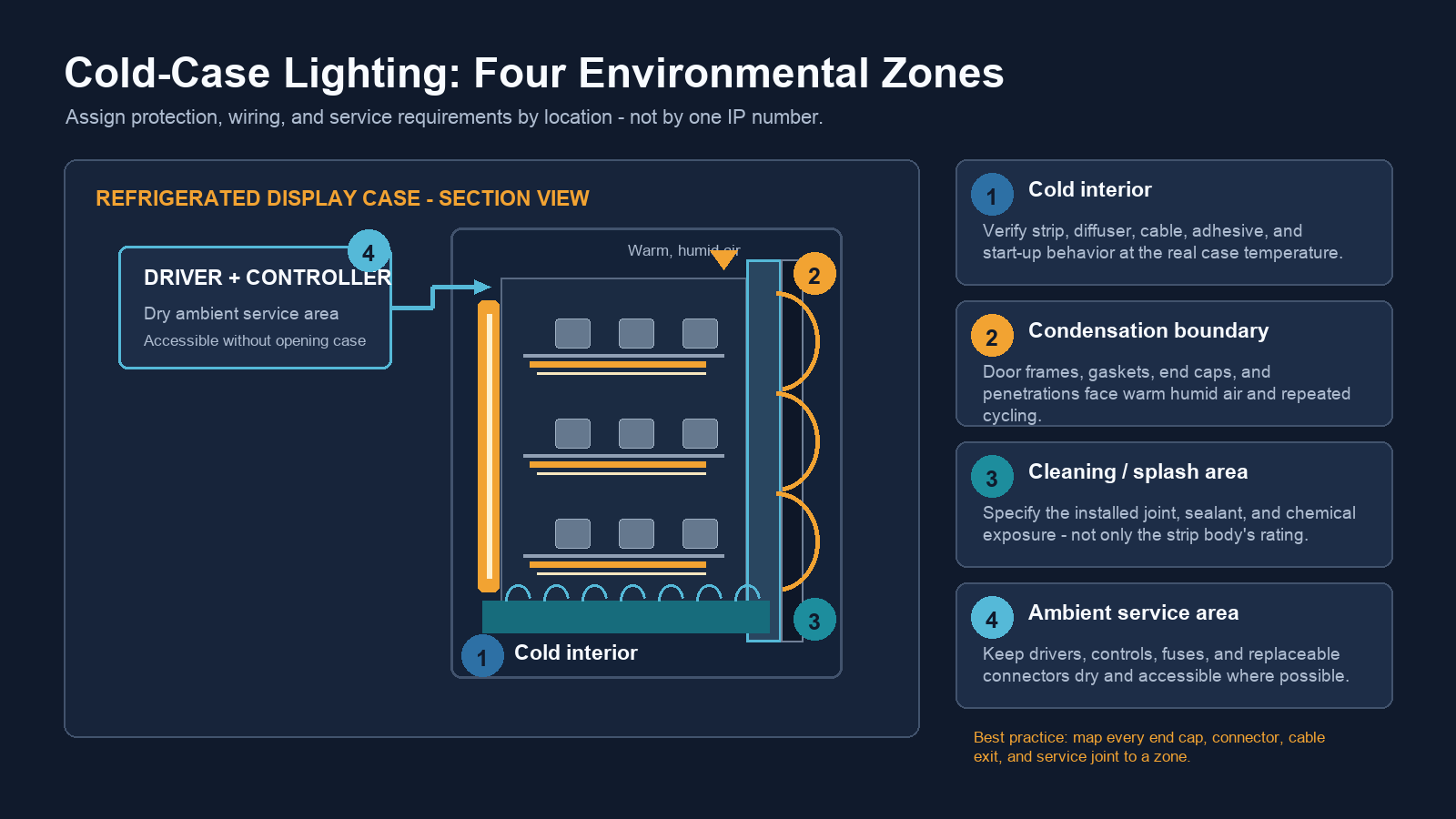
Start With Four Environmental Zones
A useful cold-case specification begins by dividing the installation into zones. This prevents one IP rating or one temperature number from being applied to every component.
This zone map leads to better questions. Is the luminaire body protected, but the cut end located at the condensation boundary? Is the driver mounted inside the cold cavity even though a dry service space is available? Does the cable leave the sealed profile through a horizontal hole where moisture can follow it? Can cleaning fluid reach a connector that was only tested in dry conditions?
Low Temperature Is Only One Line in the Test Matrix
Older U.S. Department of Energy guidance for refrigerated display-case LED lighting treated the installation as a project-level system, not merely a lamp replacement. Its performance specification included operating-temperature requirements, power-supply loading, installed-case geometry, and testing conditions.[1] The exact temperature range in any historical template should not be copied blindly into a new project, but the underlying method is still valuable: define the real case environment and test the luminaire, power supply, and installation together.
At low ambient temperature, LED output may increase relative to warm operation. That does not guarantee that the whole assembly is suitable. Drivers, electrolytic capacitors, cable jackets, adhesives, solder joints, diffusers, gaskets, and sealants each have their own temperature behavior. A product that is flexible at room temperature may become stiff during service. A driver may start reliably at one temperature but not another. A seal may survive cold storage yet fail after repeated defrost cycles.
| Operating state | What changes | What to inspect or measure |
|---|---|---|
| Initial pull-down | Case and components cool from room temperature. | Startup, current, visible flicker, mechanical movement, adhesive and profile retention. |
| Steady cooling | Temperature stabilizes and products reach normal display condition. | Shelf illuminance, vertical uniformity, color appearance, driver and profile temperatures. |
| Door-open recovery | Warm humid air enters and cold surfaces approach the dew point. | Condensation paths, reflected glare, moisture near end caps and cable entries. |
| Defrost cycle | Temperature and humidity shift; water may migrate. | Restart behavior, seal movement, trapped moisture, chromaticity and output after cycling. |
| Cleaning and service | Fixtures are touched, wiped, moved, or reconnected. | Ingress at joints, chemical compatibility, connector strain relief, replacement access. |
Condensation Is an Interface Problem
Designers often respond to moisture risk by specifying a higher IP rating. That helps only when the claimed protection applies to the complete installed assembly. IEC 60529 classifies enclosure protection against contact, solid foreign objects, and harmful water ingress.[2] It does not automatically prove resistance to temperature cycling, detergent, food acids, UV exposure, cable movement, or a field-cut end sealed by an installer.
For a refrigerated LED strip installation, check every transition:
- factory-molded end versus field-cut end
- strip body versus connector
- connector versus cable
- cable versus refrigerator-wall penetration
- profile versus mounting surface
- cold interior versus ambient driver compartment
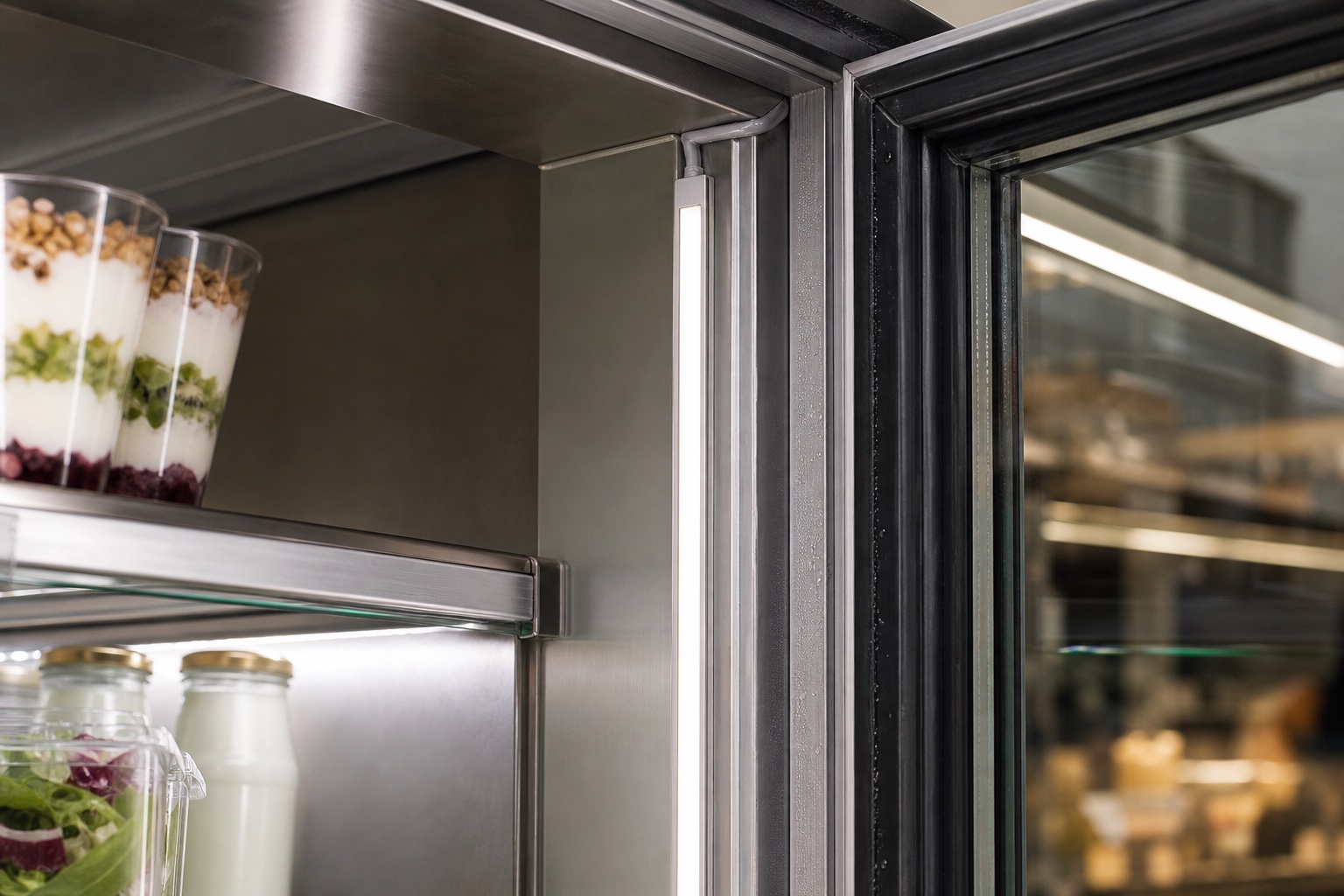
Where practical, route the cable so water cannot run toward the penetration. Use compatible glands and strain relief rather than relying on sealant alone. Avoid creating a sealed pocket that can trap moisture around a connector. If the case must be cleaned aggressively, confirm the actual cleaning method and chemical exposure before selecting the jacket, adhesive, diffuser, and sealant.
Specify Delivered Light, Not Only Lumens per Meter
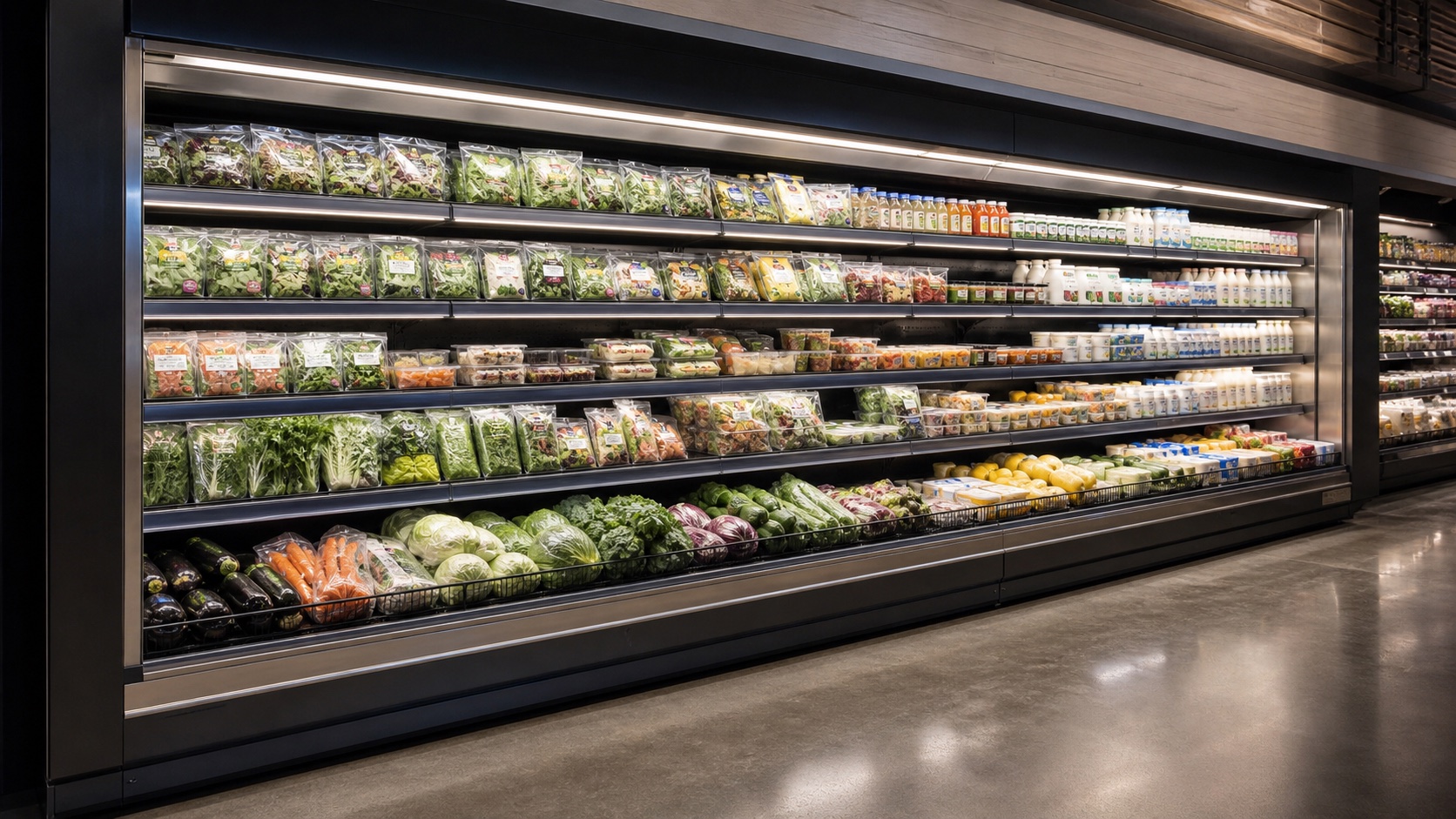
A refrigerated display case is a short-throw optical system. The light source may sit only a few centimeters from a bottle, package, shelf label, or reflective door. In this geometry, lumen output alone is a weak design metric. A high-output strip can create bright vertical edges and dark product centers. A lower-output strip with better placement and diffusion can produce a more useful display.
Define the visual result at the merchandise plane:
- minimum and maximum illuminance across each shelf
- top-to-bottom and front-to-back uniformity
- visibility of the source in glass reflections
- appearance with the door open and closed
- color quality on the actual food, beverage, label, or package type
- dimming level under normal stocking conditions
Vertical mullion lighting is useful for tall glass-door cases because it can illuminate multiple shelves from the sides. Shelf-integrated lighting gives stronger local control but creates more wiring, connectors, shadows, and service points. A center mullion may require asymmetric distribution so light reaches both adjacent bays without creating a bright line in the visitor’s reflection.
Control Reflections Before Increasing Output
Glass doors can make a technically efficient lighting system look poor. The visitor may see the LED line, the opposite aisle, ceiling lights, and their own reflection before they see the product. Increasing wattage rarely solves this. It usually makes the reflection brighter.
Use a deep enough profile, a controlled diffuser, appropriate aiming, and a mockup at the actual viewing angle. Check the case from standing and lower viewing positions, with dark and light packaging, and with adjacent aisle lighting turned on. The best placement may not be the position that produces the highest meter reading; it is the position that balances shelf visibility with source concealment.
Choose COB, SMD, or Neon Flex by Function
RH Strip Lighting’s published product data lists COB LED strip options with CRI above 90, multiple low-voltage choices, and very high LED density. That makes COB a useful starting point for shallow profiles where a smooth line is difficult to achieve. However, the standard product-page information describes indoor IP20 construction, so a refrigerated application requires a separately confirmed protective construction and project test.
SMD LED strip offers broader voltage, color, and control configurations and can work well in deeper profiles or vertical mullion systems. The optical result depends on LED spacing, profile depth, diffuser transmission, and aiming. Do not assume that a higher LED count alone guarantees uniform shelf illumination.
LED neon flex is listed with 24V and IP67/IP68 options. It can be appropriate for visible architectural lines around cold-room entrances, external case outlines, or protected luminous details. Its larger luminous body is not automatically the best choice for close merchandise lighting, where compact optics and precise aiming usually matter more.
Keep Drivers and Service Joints Out of the Cold Zone
Whenever the refrigerator design permits, place the driver, controller, fuse, and serviceable connectors in a dry ambient compartment. This reduces thermal cycling, simplifies replacement, and avoids opening the refrigerated product space for electrical service. It also makes it easier to use a driver with an operating range and safety certification appropriate to its actual environment.
Driver sizing still needs engineering discipline. A large power supply serving only a small lighting load may operate inefficiently or outside its preferred loading range; DOE’s refrigerated-case specification explicitly accounted for the actual luminaire load placed on each power supply.[1] At the other extreme, a driver should not be sized with no margin for measured strip power, wiring loss, dimming behavior, and the manufacturer’s thermal conditions.
For long case lineups, map voltage drop at the real cable length and cold-condition current. Decide whether each door, mullion, or shelf is independently replaceable. A single hidden connector should not require dismantling an entire refrigerated bay.
Do Not Treat a Refrigerator Retrofit as a Standalone Lighting Job
A refrigerated case is certified equipment, not just a cabinet. Changing its lighting can affect wiring, materials, heat load, cleaning, mechanical clearances, and the conditions under which the appliance was evaluated. UL Solutions identifies dedicated certification categories for LED retrofit conversion kits used in commercial refrigerators and freezers, and references standards including UL 1598C and UL/CSA 60335-2-89.[3]
The correct compliance path depends on the market, whether the lighting is factory-installed or field-retrofitted, and the refrigerator manufacturer’s construction. Before production, confirm responsibility with the equipment manufacturer, certification body, and local authority where applicable. A waterproof strip and a certified driver do not by themselves certify the modified refrigerator.
Build a Five-State Mockup Before Release
A useful mockup is a real case bay, not a one-meter strip on a workbench. Include the final profile, diffuser, end caps, cable length, penetration, driver, dimming level, glass door, shelves, gaskets, representative products, and cleaning method.
- Baseline at room temperature. Record input power, current, output, color, uniformity, and visible defects before cooling.
- Cold pull-down and steady operation. Confirm starting, dimming, shelf illuminance, profile temperature, and mechanical retention.
- Door-open moisture challenge. Observe where condensation forms and whether it migrates toward end caps, joints, or penetrations.
- Defrost and restart cycles. Repeat enough cycles to reveal intermittent startup, seal movement, color shift, or trapped moisture.
- Cleaning and service simulation. Wipe, open, disconnect, and replace the light as a technician would; then repeat the electrical and ingress inspection.
RFQ Checklist for Refrigerated LED Strip Projects
- Case type: open multideck, glass-door merchandiser, freezer, wine cooler, cold room, or custom cabinet
- Normal, minimum, defrost, and cleaning temperatures
- Humidity, condensation, wash, detergent, and food-contact constraints
- Mounting zone and distance from door, gasket, drain, evaporator, and product
- Required shelf illuminance, uniformity, CCT, CRI, and dimming level
- Strip voltage, run length, feed arrangement, cable length, and voltage-drop limit
- Profile, diffuser, end cap, connector, gland, sealant, and mounting method
- Driver location, loading range, control method, and restart behavior
- Factory-installed or field-retrofit compliance path
- Mockup states, cycle count, measurement method, and acceptance criteria
Specify the complete cold-case lighting assembly
Share the refrigerator type, temperature cycle, case drawing, shelf geometry, lighting target, cable route, cleaning method, and compliance market. RH Strip Lighting can help identify a practical strip, profile, protection, power, and sample-test direction.
Request a Project RecommendationConclusion
Good refrigerated display lighting is not created by selecting the highest IP number or the brightest strip. It comes from controlling the complete path from LED to merchandise: optical distribution, glass reflections, low-temperature operation, condensation boundaries, field joints, driver location, cleaning exposure, service access, and appliance compliance.
The most reliable specification starts with environmental zones and operating states. Then it selects the product family, protective construction, profile, optics, wiring, and driver around those conditions. Finally, it proves the design in a real case through pull-down, steady cooling, door opening, defrost, cleaning, and restart. That process turns a strip-light sample into a system that can survive commercial refrigeration.
References
- U.S. Department of Energy, Retailer Energy Alliances, Refrigerated Display Case LED Lighting Performance Specification.
- International Electrotechnical Commission, IEC 60529: Degrees of protection provided by enclosures (IP Code).
- UL Solutions, FAQ: UL Certified LED Retrofit Luminaire Conversion Kits.
Request a Project or Trade Quote
Sourcing for an installation project, resale or OEM production? Share your requirements below. You can discuss project samples before committing to a bulk order.
Related Articles

LED Strip Lighting After a Power Outage: Designing a Reliable Restart
Plan LED strip power restoration beyond total watts. Review driver inrush, switching limits, restart scenes, and commissioning before project handover.

Why LED Strip Lights Buzz When Dimmed: A Guide for Quiet Spaces
Diagnose LED strip buzzing without guessing. Review drivers, PWM controls, mounting resonance, and low-level acoustic acceptance for quiet interiors.
LED Strip Lighting for Modular Retail Shelves: Design for Reconfiguration
Specify modular shelf lighting beyond driver wattage. Check shared-feed current, connector durability, cable movement, controls, and approved configurations.