
LED Strip Lighting for Museum Display Cases and Gallery Details
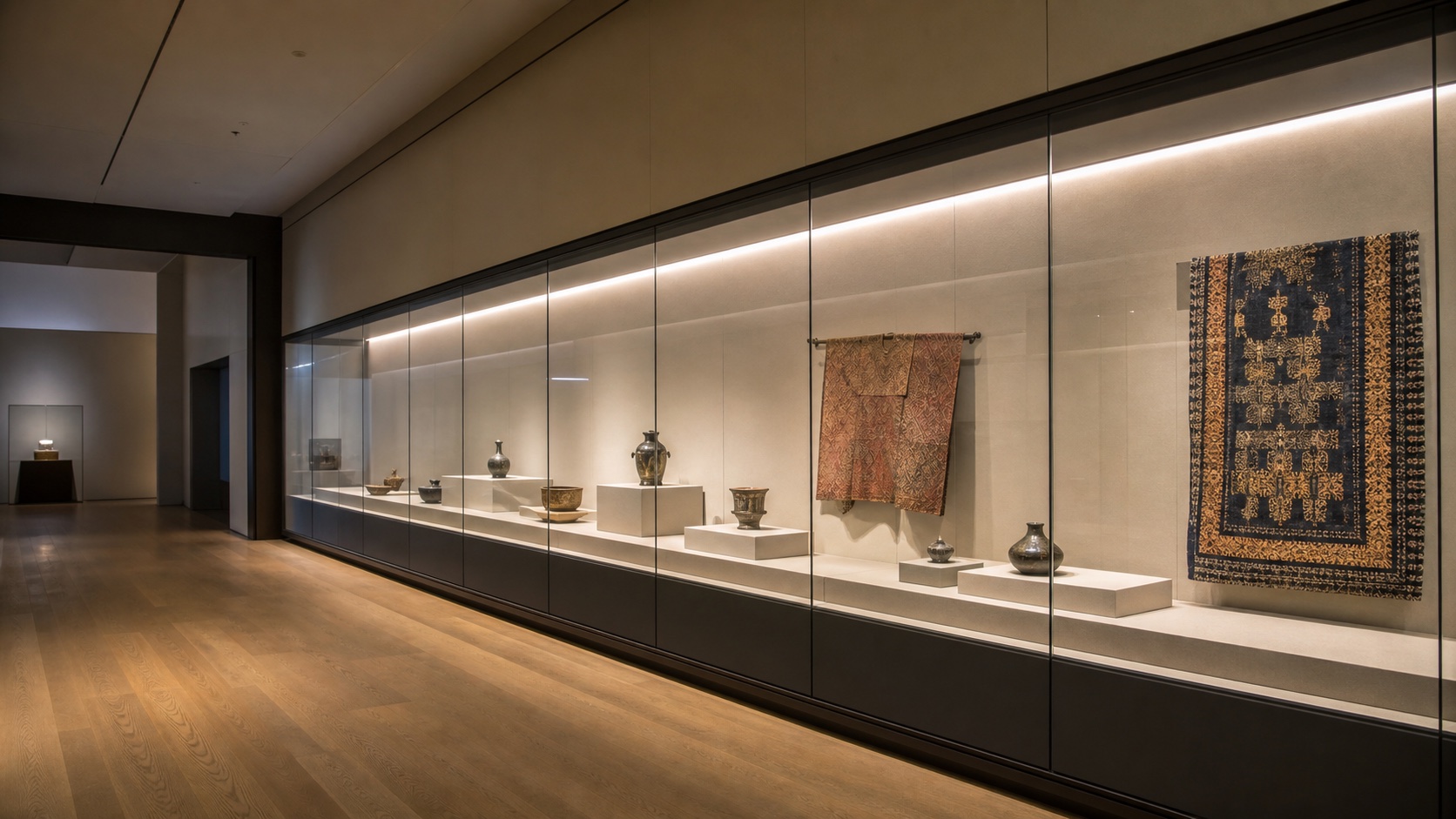
Museum display cases and gallery details are a different category of LED strip lighting. In retail, the main goal is usually to make products attractive. In museums, galleries, archives, and exhibition spaces, the lighting has two jobs that can conflict: help visitors see the object today and avoid unnecessary damage to the object over time.
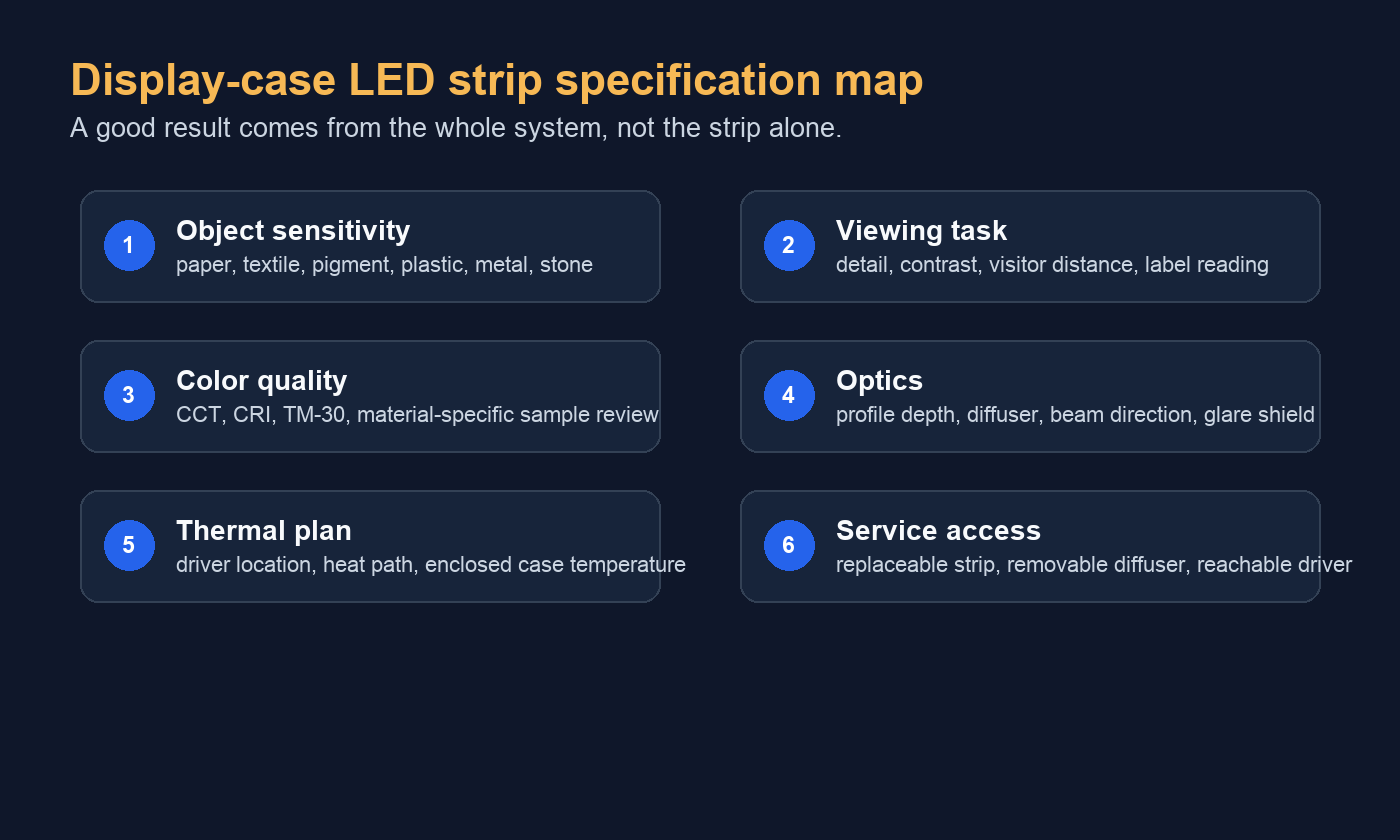
This is why a museum-grade LED strip project cannot start with brightness alone. It must start with object sensitivity, viewing distance, color quality, heat control, glare control, annual exposure, and service access. The strip is only one component in that system.
The Core Insight: Museum Lighting Is a Dose Problem
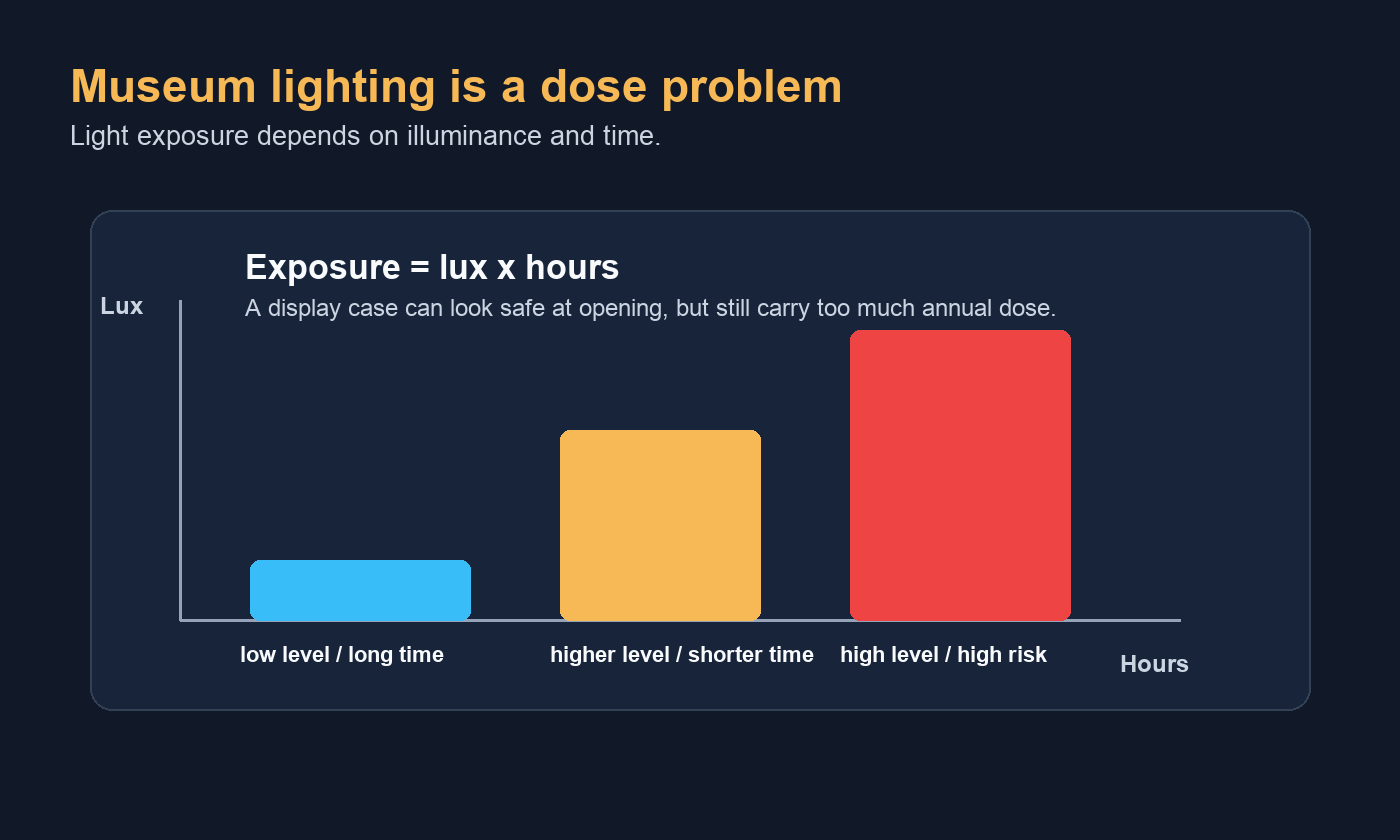
For sensitive objects, the question is not simply whether the light is LED, warm, dimmable, or low wattage. The more important question is total exposure. The Canadian Conservation Institute explains that light damage depends on illuminance and time, and museum practice often considers exposure in lux-hours rather than only instant brightness.[1]
That changes the way LED strip lighting should be specified. A display case that runs at a modest light level all day may create more annual exposure than a brighter detail used only during guided viewing. A dim strip installed very close to a sensitive object can still be risky if it operates continuously. A beautiful case light can be a conservation problem if it cannot be controlled by schedule, sensor, dimming, or exhibit policy.
Why LEDs Are Useful, But Not Automatically Museum-Safe
LEDs are attractive for museum and gallery projects because they can be compact, controllable, low profile, and available in many CCT and color-quality options. They also generally reduce some problems associated with older light sources. But LED quality varies widely, and the Canadian Conservation Institute’s technical bulletin on LED lighting in museums notes that the transition from older sources to LEDs is not simple because LED lamps vary significantly in light quality.[2]
For LED strip lighting, this matters even more. Many strips are designed for cabinets, retail shelves, coves, signs, or furniture. Those products may be visually useful, but they are not automatically suitable for conservation-sensitive displays. A museum display case needs attention to spectrum, thermal behavior, dimming, product consistency, and long-term replacement.
| Common assumption | Better museum lighting question |
|---|---|
| “It is LED, so it is safe.” | What is the object’s sensitivity, exposure time, spectrum, heat condition, and control strategy? |
| “Low wattage means low risk.” | What illuminance reaches the object, and how many hours per year does it operate? |
| “High CRI is enough.” | Does the product render the specific object materials well at the selected CCT and dimming level? |
| “The strip is hidden, so it is fine.” | Does the profile control glare, reflections, heat, maintenance access, and cable shadows? |
Use LED Strip as a Layer, Not the Whole Lighting Strategy
In museum display cases, LED strip lighting works best as a controlled layer. It can provide edge illumination, shelf illumination, soft grazing, label lighting, or low-level internal case light. It should not be treated as a universal replacement for every spotlight, wall washer, or case optic.
The most effective uses include:
- low-profile linear light inside display cases
- hidden edge lighting for plinths, vitrines, or object bases
- soft backlighting for non-sensitive interpretive graphics
- controlled label or shelf lighting where glare is shielded
- architectural gallery details that support orientation without shining directly on sensitive objects
The weakest uses are usually direct-view strips near glass, exposed dots reflected in vitrines, strips placed too close to paper or textile objects, and high-output runs inside sealed cases without a heat path.
Choose the Product Family by the Display Problem
COB LED strip is often useful when the display case needs a smoother line in a shallow profile. It can reduce visible dotting near glass, polished acrylic, or reflective object surfaces. SMD LED strip can be practical when the strip sits deeper inside a channel, when a broader specification range is needed, or when output is the priority. LED neon flex is more appropriate when a diffused luminous line is itself part of the gallery architecture, rather than a light source aimed at sensitive objects.
Color Quality Is About the Object, Not the Datasheet Alone
Good museum lighting must show material character: old paper, textile fibers, pigment, ceramic glaze, metal patina, stone surface, wood grain, or colored plastic. A high CRI value can be useful, but it does not tell the whole story. The Illuminating Engineering Society’s recent color-rendition guidance is built around a broader TM-30 framework for specifying color rendition goals across design phases.[3]
For display-case LED strips, the practical approach is to evaluate the sample on the real object material or a close surrogate. Look at the object under the selected CCT, at the planned dimming level, through the actual glass or acrylic, with the actual profile and diffuser. A strip that looks clean on a white table can make an aged paper, dark textile, or polished metal object look wrong inside the case.
Glare and Reflections Can Ruin a Good Specification
Display cases add optical problems that normal cabinet lighting does not. Glass reflects the strip, the visitor, the gallery, and nearby exhibits. A product can be technically smooth and still appear as a distracting line in the case glass. This is especially common when the strip is mounted too close to the front edge or aimed toward the visitor’s viewing angle.
To reduce glare and reflections, consider:
- recessing the strip deeper into the case structure
- using a lensed or shielded aluminum profile
- aiming light across the object rather than toward the viewer
- using lower output with better distribution instead of one bright line
- testing reflections from standing and seated viewing positions
- checking the case after labels, plinths, and final glass are installed
For premium display cases, a reflection test is not optional. It is often the difference between a professional installation and a distracting one.
Heat Still Matters Inside Display Cases
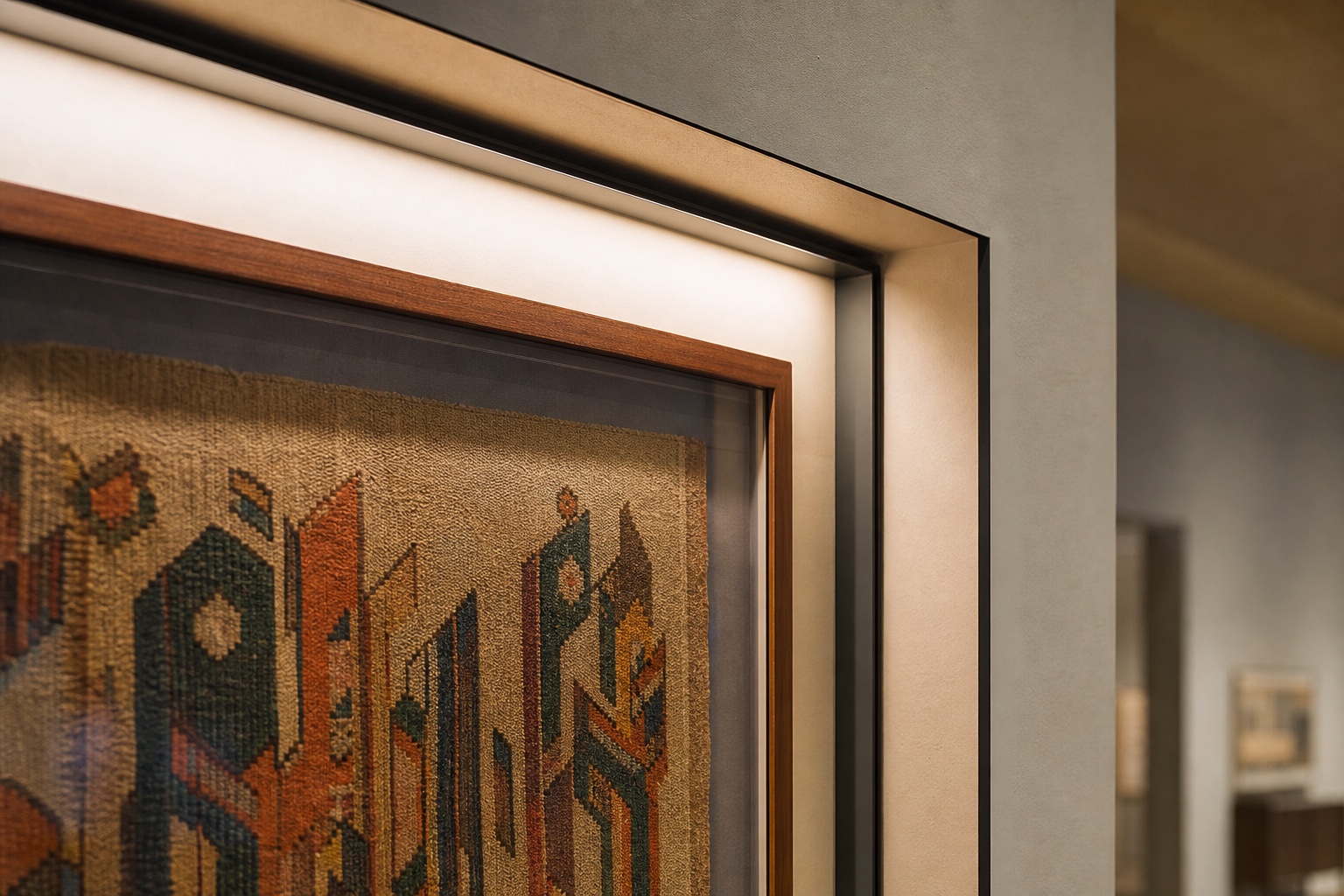
LED strips are efficient, but they still produce heat. In an open shelf, heat can often dissipate naturally. In a sealed or semi-sealed museum case, the heat path is more restricted. That can affect LED life, adhesive reliability, driver performance, and the microclimate inside the case.
Use aluminum profiles as heat paths, not just as decorative trim. Keep drivers outside the sealed object space where possible. Avoid placing high-output strips directly above heat-sensitive objects without testing. If the display case has strict environmental requirements, lighting should be reviewed with the case designer or conservation team.
Build the Mockup Around the Real Case
A museum display lighting mockup should not be a strip lying on a table. It should include the case glass or acrylic, the intended profile, diffuser, driver, dimming method, mounting distance, cable exit, and at least a representative object material. The mockup should be reviewed at the planned visitor distance and from side angles, not only from straight ahead.
For sensitive collections, the mockup should also define the control plan: operating hours, dimming limit, sensor logic, maintenance procedure, and whether the strip can be replaced without opening the object area.
Specification Checklist for Museum and Gallery LED Strip Projects
- Object sensitivity and allowed display strategy
- Target illuminance at object surface, not only strip output
- Annual exposure plan: brightness and operating hours
- CCT and color-rendition requirements reviewed on real materials
- Profile, diffuser, shield, and viewing-angle test
- Driver location and thermal path
- Dimming compatibility and control method
- Replacement access for strip, diffuser, driver, and cable
- Sample approval under final case glass or acrylic
Need a display-case lighting recommendation?
Send RH Strip Lighting your case drawing, object type, viewing distance, CCT target, dimming method, profile space, driver location, and required installation length. We can help compare COB LED strip, SMD LED strip, LED neon flex, profiles, diffusers, and wiring options for your project.
Conclusion
LED strip lighting can be excellent for museum display cases and gallery details, but only when it is specified as part of a conservation-aware lighting system. The key is not maximum brightness. The key is controlled visibility: enough light for visitors to understand the object, the right color quality to respect the material, limited exposure over time, controlled heat, minimal glare, and a serviceable installation.
For serious projects, choose the strip after the display strategy is clear. Define the object sensitivity, geometry, viewing task, exposure plan, optics, driver access, and maintenance method first. Then test the actual strip, diffuser, and case construction before production.
References
- Canadian Conservation Institute, Agent of Deterioration: Light, Ultraviolet and Infrared.
- Canadian Conservation Institute, LED Lighting in Museums and Art Galleries – Technical Bulletin 36.
- Illuminating Engineering Society, ANSI/IES LP-30-26, Lighting Practice: A Comprehensive Guide to Specifying Color Rendition.
Request a Project or Trade Quote
Sourcing for an installation project, resale or OEM production? Share your requirements below. You can discuss project samples before committing to a bulk order.
Related Articles
LED Strip Lighting After a Power Outage: Designing a Reliable Restart
Plan LED strip power restoration beyond total watts. Review driver inrush, switching limits, restart scenes, and commissioning before project handover.

Why LED Strip Lights Buzz When Dimmed: A Guide for Quiet Spaces
Diagnose LED strip buzzing without guessing. Review drivers, PWM controls, mounting resonance, and low-level acoustic acceptance for quiet interiors.
LED Strip Lighting for Modular Retail Shelves: Design for Reconfiguration
Specify modular shelf lighting beyond driver wattage. Check shared-feed current, connector durability, cable movement, controls, and approved configurations.