
LED Strip Lighting for Curved Walls, Columns, and Arched Details
Curved walls, round columns, arched ceilings, circular coves, and curved reception desks can make LED strip lighting look more architectural than a straight line ever could. They can also expose mistakes faster. A product that works well in a straight aluminum profile may twist, show dots, separate from the mounting surface, or aim light in the wrong direction when the detail becomes curved.
The practical question is not simply whether an LED strip is flexible. The real question is whether the product can bend in the required direction, maintain a clean light line, manage heat, stay serviceable, and match the viewing angle of the space.
Curved Details Fail When the Product Bends the Wrong Way
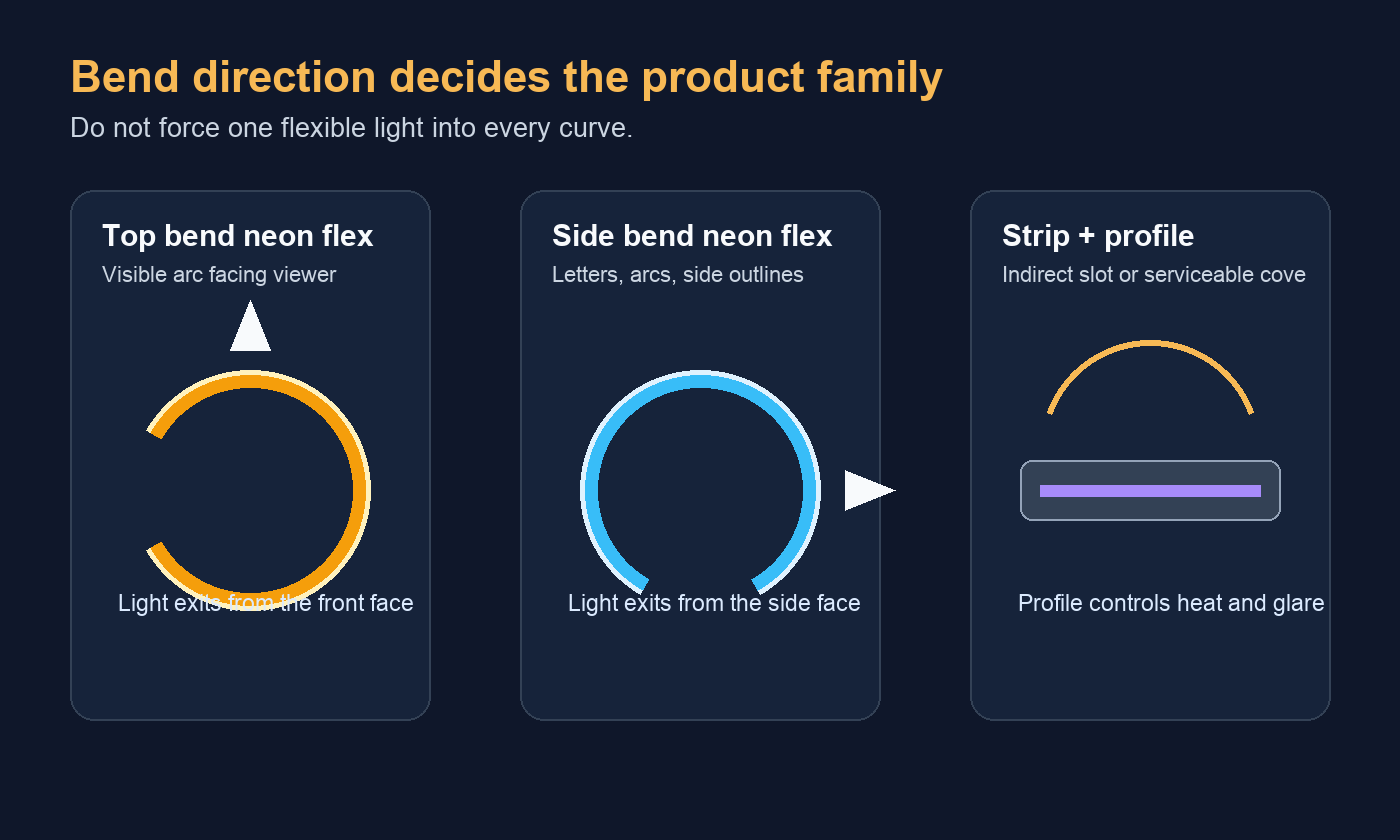
Many LED products are called flexible, but they do not all flex in the same direction. A standard LED strip bends easily along its length on a flat plane, but it is not designed to twist sharply or wrap cleanly around every three-dimensional form. LED neon flex is also not one product. Top-bend, side-bend, and 360-degree styles behave differently, and choosing the wrong one can make a curve look forced.
For a round column, the most important decision is usually whether the light line must face outward, wash the nearby surface, or trace the side profile. For an arch, the design may need a continuous visible line, a hidden indirect glow, or a narrow reveal. Each effect points to a different product family.
Do Not Treat Minimum Bend Radius as a Universal Number
One common mistake is asking for “the bend radius of LED strip” as if there is one standard answer. There is not. Minimum bend radius depends on PCB width, LED package, silicone extrusion, diffuser structure, solder-pad layout, waterproof jacket, cutting interval, and whether the curve is continuous or interrupted by joints.
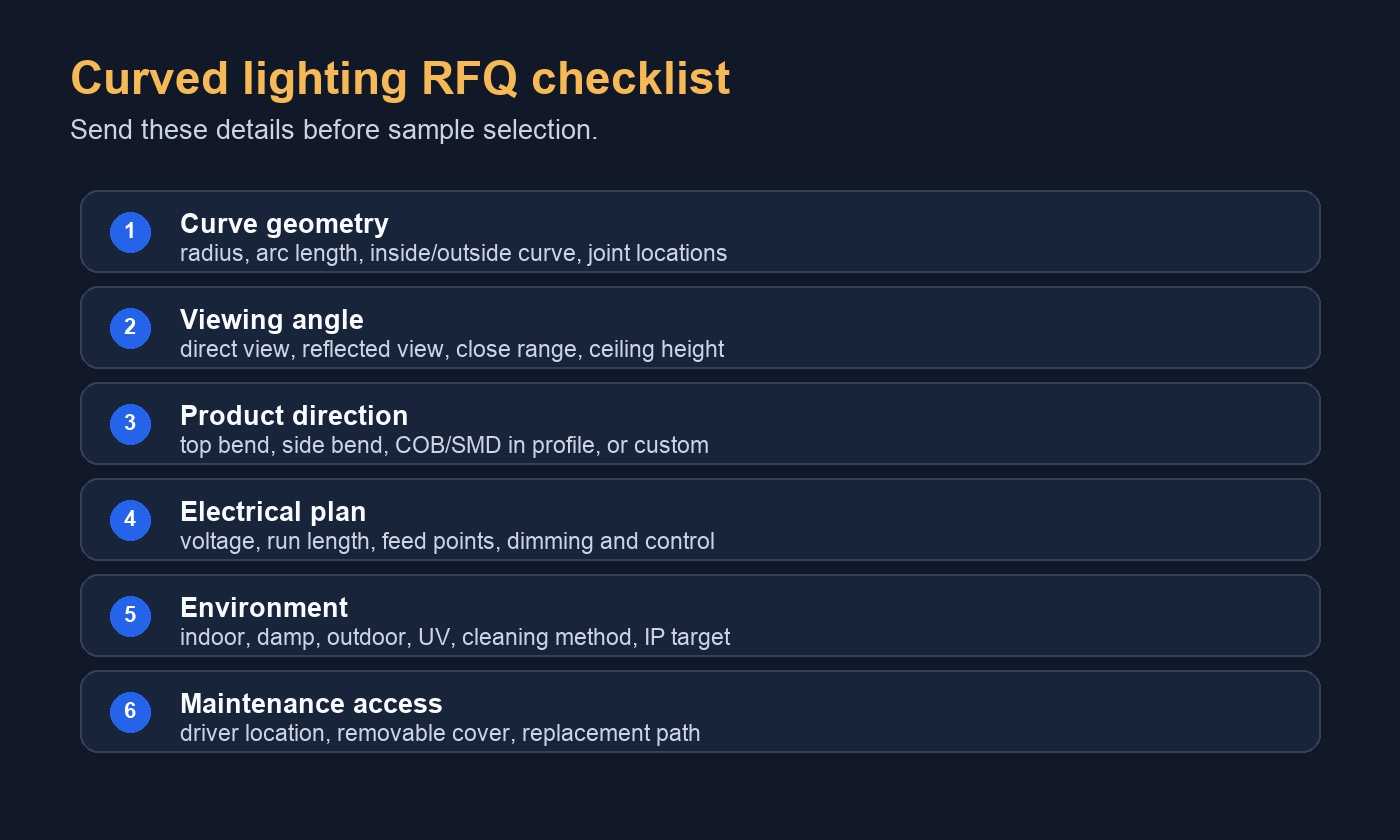
For professional projects, the safer approach is to define the geometry first:
- inside radius and outside radius of the curve
- arc length and total illuminated length
- whether the curve is horizontal, vertical, or three-dimensional
- whether the light line is visible directly or reflected indirectly
- where the feed cable, connector, and driver can be hidden
- whether the light must be removable after wall or millwork completion
After that, compare the actual product datasheet and sample. A small one-meter mockup is more valuable than a confident number in an email. It shows whether the product sits flat, whether the diffuser opens or wrinkles, whether the line remains uniform, and whether installers can repeat the detail on site.
Choose Between LED Neon Flex and Strip-in-Profile by the Visual Goal
LED neon flex is often the better answer when the light line itself is visible. The silicone or PVC body acts as the diffuser, protects the light source, and creates a continuous luminous form. It is useful for arches, outlines, curved counters, signage-like details, and places where the line is meant to be seen.
LED neon flex is not automatically better for every curve, though. If the design intent is a hidden glow on a curved wall or circular ceiling cove, a strip inside a profile may give more control. The profile can manage heat, define the beam direction, hide the LED points, and make service easier. COB LED strip can be useful where a shallow profile needs a smoother line, while SMD LED strip remains practical when the strip is recessed deeply enough or brightness is the priority.
| Design condition | Better starting direction | Why it matters |
|---|---|---|
| Visible luminous arc | Top-bend or side-bend LED neon flex | The diffuser is part of the product, so the line can be visually continuous. |
| Hidden curved cove | SMD or COB strip in profile | The profile controls beam direction, heat, and maintenance access. |
| Small-radius letters or outlines | Side-bend neon flex | The product bends in the plane of the outline instead of fighting the curve. |
| Close-view premium interior detail | COB strip or high-density SMD with diffuser | Dot visibility and reflected points become more obvious at close range. |
Color Quality Still Matters on Curved Surfaces
Curved surfaces often reveal more than the light line. They reveal material color, shadow, reflected highlights, and uneven saturation. A warm wood column, stone arch, or painted circular wall can look different under strips with the same CCT but different color rendering behavior.
The U.S. Department of Energy explains that LEDs can achieve a wide range of color qualities, but higher fidelity often involves tradeoffs in cost and efficiency.[1] For projects where curved lighting touches wood, fabric, stone, metal, or brand-colored surfaces, CRI alone may not be enough. DOE’s TM-30 guidance describes TM-30 as a broader method for evaluating color rendition than older single-number approaches.[2]
That does not mean every project needs a complex color report. It means the sample should be reviewed on the real material, at the real dimming level, and from the normal viewing angle. A curved surface changes angle continuously, so one front-view photo is not enough.
Glare and Reflections Become More Complicated on Curves
A straight wall reveal usually has predictable viewing angles. A column or curved wall does not. As a person walks past the surface, the light source may move from hidden, to reflected, to directly visible. This is why curved LED details should be tested from multiple positions.
Common glare problems include:
- visible bright points reflected on glossy stone, glass, lacquer, or metal
- a light line that appears smooth from the front but broken from the side
- a neon flex body that looks too thick for a narrow architectural reveal
- driver or cable shadows at the start of the curve
- uneven brightness where connectors or joints interrupt the arc
The solution is usually a combination of deeper recess, better diffuser, lower wattage, dimming, alternate product direction, or a different mounting location. More brightness rarely fixes a glare problem. It usually makes the problem easier to see.
Plan Power Feed and Voltage Drop Before the Curve Is Built
Curved details often hide the power feed inside millwork, ceiling slots, column cladding, or wall panels. That makes the electrical plan harder to repair later. Before production or installation starts, confirm the feed location, maximum run length, driver capacity, voltage, dimming method, and whether power injection is needed.
Long circular coves and large arches may need multiple feed points to keep brightness even. If power is fed from only one end, the far end can dim or shift color. If the feed location is placed at the most visible part of the curve, the connector can create a dark spot or bulky transition.
For low-voltage lighting systems, safety and compliance should be treated as part of the specification, not a final accessory decision. UL 2108 covers low-voltage lighting systems and components intended for installation under NEC Article 411, including Class 2 and other low-voltage luminaires and lighting systems.[3] For project buyers, that means the strip, neon flex, driver, wiring method, and installation environment should be discussed together.
Service Access Is Often the Difference Between Premium and Risky
A curved lighting detail can look excellent on opening day and still be a poor design if the product cannot be replaced. Columns, arches, and circular coves are often finished with stone, wood veneer, plaster, or custom panels. Once closed, access may be expensive or impossible.
Before approving the final detail, ask:
- Can the diffuser or cover be removed without damaging the finish?
- Can the strip or neon flex be replaced in sections?
- Where are the drivers located, and can they be reached?
- Are connectors hidden in a serviceable cavity or buried inside finished work?
- If one arc segment fails, does the entire feature need to be reopened?
For curved architectural work, the cleanest visual design is not always the best construction design. A slightly wider reveal or removable cover may protect the project from much higher service cost later.
Recommended Specification Workflow
For curved walls, columns, and arched details, RH Strip Lighting recommends a staged workflow:
- Define the curve. Share radius, arc length, drawing, mounting surface, and whether the line is visible or indirect.
- Select the product direction. Decide between top-bend neon flex, side-bend neon flex, 360-degree neon, COB strip, or SMD strip in profile.
- Check visual risk. Review dot visibility, glare, reflections, diffuser thickness, and material color.
- Plan power and control. Confirm voltage, feed points, driver access, dimming method, and control system.
- Build a mockup. Test the real curve and material before bulk production.
- Confirm service access. Make sure the final construction can be maintained.
Need help choosing the right curved lighting product?
Send RH Strip Lighting your drawing, radius, installation length, surface material, desired effect, CCT, IP requirement, and control method. We can help compare LED neon flex, COB LED strip, SMD LED strip, profiles, diffusers, drivers, and wiring options for the project.
Conclusion
Curved LED strip lighting is not only a question of flexibility. It is a system decision involving bend direction, light output, diffuser behavior, heat, power feed, voltage drop, surface reflection, installation access, and long-term maintenance. When those details are planned early, curved walls, columns, arches, and circular coves can look deliberate and refined. When they are left to site improvisation, the same design can become uneven, bulky, or difficult to repair.
The safest path is to treat the curve as a project detail, not a generic LED strip order. Share the drawing, test the actual material, build a short curved mockup, and choose the product family around the way the light must bend and be seen.
References
- U.S. Department of Energy, LED Basics.
- U.S. Department of Energy, TM-30 Frequently Asked Questions.
- UL Standards & Engagement, UL 2108 Low Voltage Lighting Systems.
Request a Project or Trade Quote
Sourcing for an installation project, resale or OEM production? Share your requirements below. You can discuss project samples before committing to a bulk order.
Related Articles
LED Strip Lighting After a Power Outage: Designing a Reliable Restart
Plan LED strip power restoration beyond total watts. Review driver inrush, switching limits, restart scenes, and commissioning before project handover.
Why LED Strip Lights Buzz When Dimmed: A Guide for Quiet Spaces
Diagnose LED strip buzzing without guessing. Review drivers, PWM controls, mounting resonance, and low-level acoustic acceptance for quiet interiors.
LED Strip Lighting for Modular Retail Shelves: Design for Reconfiguration
Specify modular shelf lighting beyond driver wattage. Check shared-feed current, connector durability, cable movement, controls, and approved configurations.