
LED Strip Lighting for Commercial Kitchens: Hygiene, Heat, Glare, and Service Access
A commercial kitchen is one of the easiest places to overspecify an IP rating and still build the wrong LED strip system. The same room contains food-handling surfaces, grease, steam, detergent spray, hot equipment, cold equipment, reflective stainless steel, long operating hours, and narrow maintenance windows.
The useful question is not, “Which waterproof strip should we use?” It is, “What reaches this exact lighting detail, what must be kept clean, what must remain visible, and how will the complete assembly be replaced without contaminating or closing the work zone?”
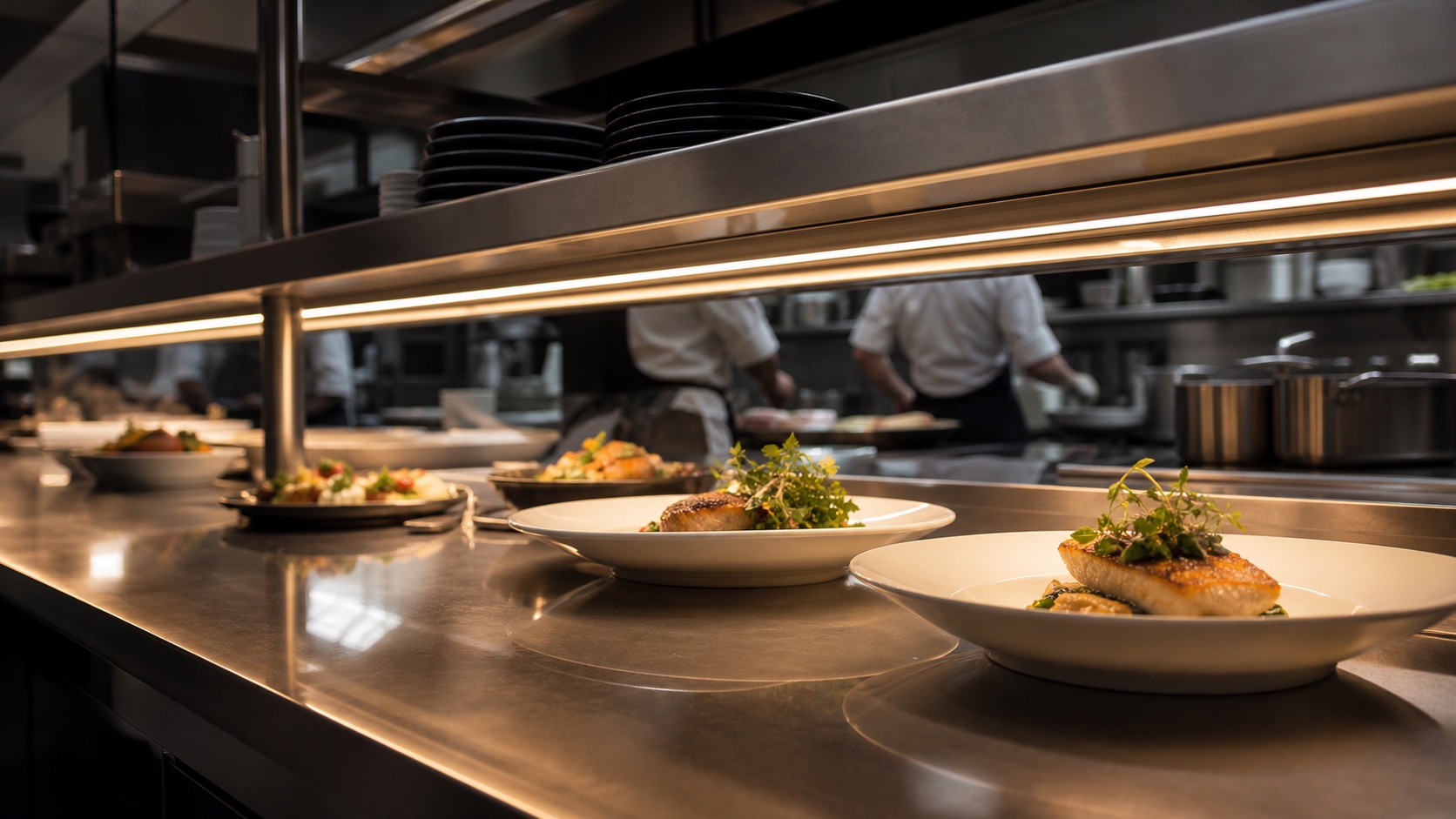
Map Four Zones Before You Select a Product
A strip under a dining-side pass shelf and a strip beside a warewasher may be only ten meters apart, but they do not have the same exposure or compliance path. Divide the project by actual conditions rather than calling the entire kitchen “wet.”
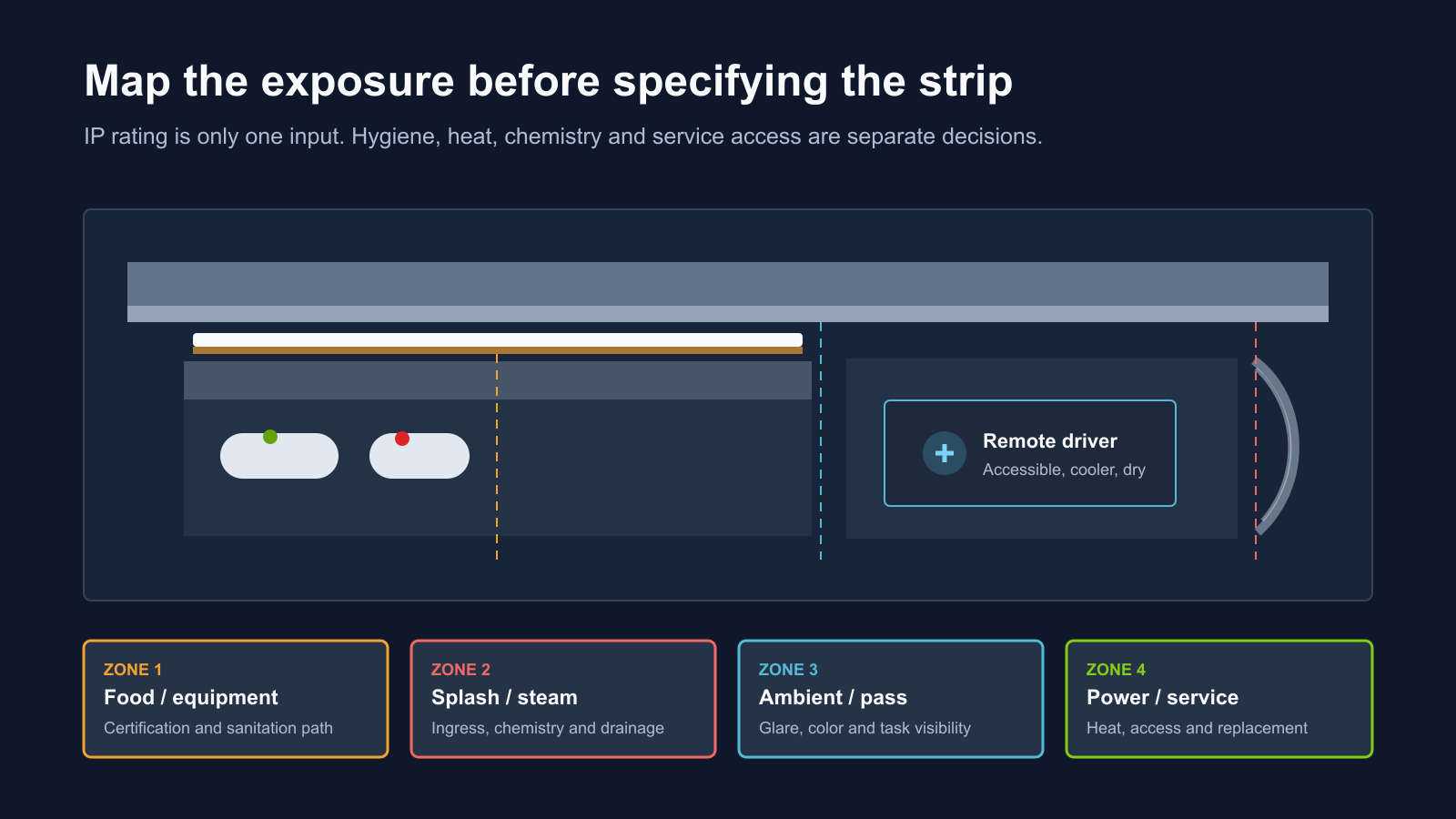
This boundary model changes the bill of materials. A shallow COB profile may be appropriate on the guest-facing side of a dry pass. A sealed SMD assembly may suit a damp shelf outside direct spray. A warewashing edge may need a listed luminaire or equipment-integrated solution rather than a field-built strip detail. Drivers and dimming components may belong in a remote service zone even when the strip is close to the task.
Start With the Work Surface, Not the Reel Output
LED-strip datasheets usually report lumens per meter under controlled conditions. Kitchen requirements are judged at work surfaces after losses from the diffuser, profile, mounting distance, shielding, grease film and voltage drop. The reel value is therefore an input, not the acceptance result.
The 2022 U.S. FDA Food Code identifies different illuminance levels for different functions: at least 108 lux in areas such as walk-in refrigeration and dry storage; 215 lux at locations including self-service food, inside reach-in equipment and warewashing or utensil-storage areas; and 540 lux where employees work with food, utensils or equipment such as knives and slicers when safety is a factor.[1] These are a valuable reference, but the adopted local code and project requirements control.
Build a measurement schedule before selecting wattage:
- identify the exact horizontal or vertical measurement plane
- record the minimum and average illuminance target
- include surrounding ambient light and the intended operating scene
- measure after the final diffuser, shield and stainless-steel shelf are installed
- check the darkest point, not only the center below the strip
- repeat the test after thermal stabilization and at the end of the longest run
A brighter strip is not always the answer. Moving the profile toward the front of a shelf can reduce hand shadow. A wider beam can improve uniformity. A deeper shield can remove direct glare while preserving light on the cutting plane. Solve geometry before adding power.
Why IP67 Can Still Be the Wrong Specification
IEC 60529 defines the IP Code as a classification of the degrees of protection provided by enclosures.[2] That is important, but it is narrower than many kitchen specifications imply. An IP67 claim does not automatically answer these questions:
- Can exposed surfaces be cleaned without grooves that trap soil?
- Will grease, alkaline detergent or sanitizer attack the jacket, end cap, adhesive or diffuser?
- Can condensation drain away rather than collect around a cable entry?
- Is the complete cut length sealed, or only the uncut product construction?
- Does the mounting method create an inaccessible ledge above food?
- Is the finished assembly accepted within the food-equipment or electrical compliance path?
NSF explains that NSF/ANSI 2 covers minimum food-protection and sanitation requirements for the materials, design, fabrication, construction and performance of food-handling and processing equipment, including counters, hoods, shelves and sinks. NSF/ANSI 51 addresses materials and finishes used in commercial food-service equipment and components.[3] This does not mean every light near a kitchen requires the same certification. It means the equipment manufacturer, kitchen consultant and authority should decide whether the lighting is an external luminaire, a component of listed equipment, or part of a custom sanitation-critical assembly.
Steam, Grease and Cleaning Chemistry Fail Different Parts
Steam does not behave like rain. Warm vapor rises, condenses on cooler metal, travels along horizontal ledges and can enter a cable path far from the visible source. Grease creates an insulating film that reduces light and traps heat. Cleaning chemicals may cause swelling, cracking, discoloration or loss of adhesion even when water ingress is controlled.
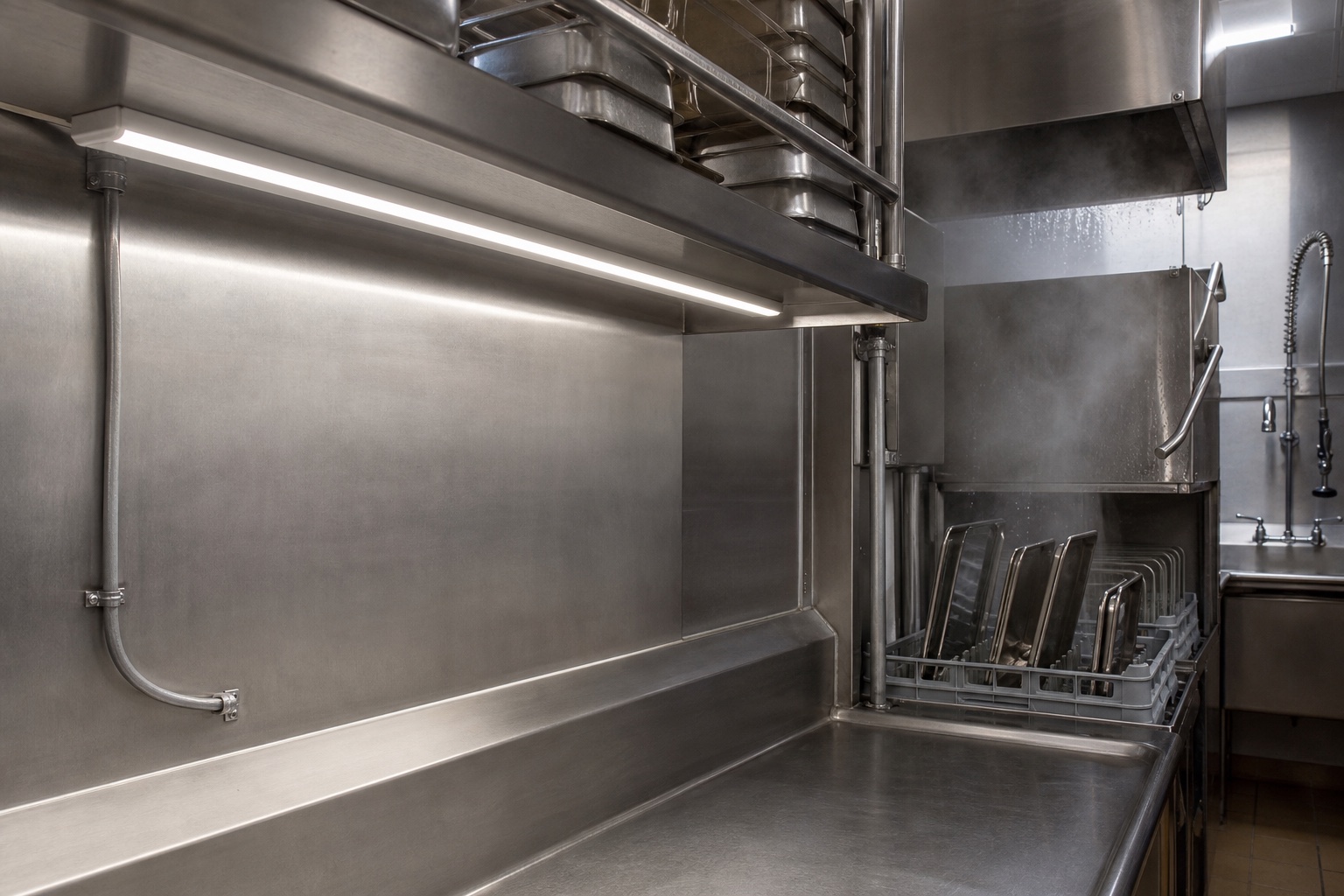
For each location, record the exposure source and cleaning procedure. Ask whether the fixture is wiped, sprayed or pressure washed; which chemical is used; at what concentration and temperature; how often cleaning occurs; and whether staff can see and reach every surface. Request material-compatibility evidence for the complete assembly, including the diffuser, sealant, end caps, cable jacket, glands and mounting clips.
Use geometry to reduce exposure:
- keep the profile out of direct spray and out of the plume above steam-producing equipment
- avoid upward-facing channels, open ends and cable entries that become reservoirs
- route cables with a deliberate drip path rather than toward a connector or driver
- use mechanical retention; heat, grease and detergent make adhesive-only mounting unreliable
- avoid field joints inside the harsh zone where a continuous factory-finished length is possible
- place replaceable power and control components in a cooler accessible location
Stainless Steel Turns Brightness Into Glare
Commercial kitchens contain large specular surfaces. A strip hidden under a shelf can still appear as a bright reflected line in the backsplash, worktop or equipment door. Polished utensils and wet surfaces multiply highlights. Increasing output to overcome shadow can make the source more uncomfortable without improving visibility.
Review the detail from three viewpoints: the employee’s normal eye position, the task plane and, for open kitchens, the guest’s view through the pass. A deeper profile, wider diffuser, asymmetric shield or changed setback often solves more than dimming alone. Position the light to illuminate the front of the task instead of creating a shadow from the shelf edge or the worker’s hands.
For a pass, coordinate the scene with the dining room. The kitchen side may need strong neutral task light while the guest-facing plate should not look washed out against a warmer restaurant interior. Separate circuits or controlled zones can preserve both functions.
Specify Food Color Beyond CRI
CRI 90+ is a sensible starting point for passes and display counters, but it does not fully describe whether greens look fresh, red meat appears natural or warm sauces become oversaturated. The U.S. Department of Energy describes ANSI/IES TM-30-24 as a system of related measures and graphics for evaluating and communicating color rendition, with more information than a single legacy index.[4]
For food-facing zones, request spectral test data and review at least fidelity, gamut and the hue-angle graphics rather than approving on CCT and CRI alone. Do not set a universal saturation target for every cuisine. A bakery, sushi counter, butcher display and plant-forward restaurant may prefer different emphasis. Use the actual plate, garnish, stainless finish and dining-room light in the mockup.
As a practical starting range, 3500K to 4000K often supports clean task visibility in back-of-house preparation, while 3000K to 3500K can integrate more comfortably at a guest-facing pass. These are design starting points, not compliance values. The final choice should be judged with the real food, material palette and dimming level.
Choose the Product Family by Exposure and Optics
SMD LED strip offers broad output, voltage, CCT and density options. In commercial kitchens it is usually considered as part of a profile or purpose-built assembly, not as bare tape. A deeper profile and opal diffuser can deliver broad task light while keeping individual LEDs out of direct view.
COB LED strip creates a smoother line in shallow guest-facing passes and close-view millwork. RH’s standard COB construction is described as indoor IP20, so a dry-zone use should not be extended into steam or wash exposure without a separately confirmed construction.
LED neon flex can form a durable, self-diffused visible line for architectural bar fronts or circulation edges. Its larger section and sealed construction may be useful outside food-preparation surfaces, but “more waterproof” does not automatically make it the most hygienic or optically efficient task-light solution.
Related technical decisions are covered in RH’s guides to aluminum profiles and thermal management, CRI for commercial projects, LED strip dimming methods, and installed lumen losses.
Keep the Driver Cool, Dry and Replaceable
A sealed strip does not protect an exposed driver, controller or connector. Drivers placed above hot cooking equipment see higher ambient temperature and shorter life. Drivers hidden inside welded stainless-steel shelves may be impossible to replace without taking equipment out of service.
Where the equipment design allows, keep exposed-zone wiring low voltage and move the driver to an accessible service location. Confirm voltage drop at full length and operating temperature. Avoid locating connectors above exposed food or in condensation paths. Label circuits and provide enough cable and clearance to remove a profile without pulling a solder joint.
Electrical listing and installation requirements depend on market and system architecture. UL Solutions identifies safety-testing and certification paths for luminaires, LED equipment and low-voltage lighting systems.[5] A certified strip or driver does not automatically certify a custom shelf assembly; coordinate the complete system with the equipment fabricator, electrical designer and local authority.
Design Maintenance Into the Stainless-Steel Detail
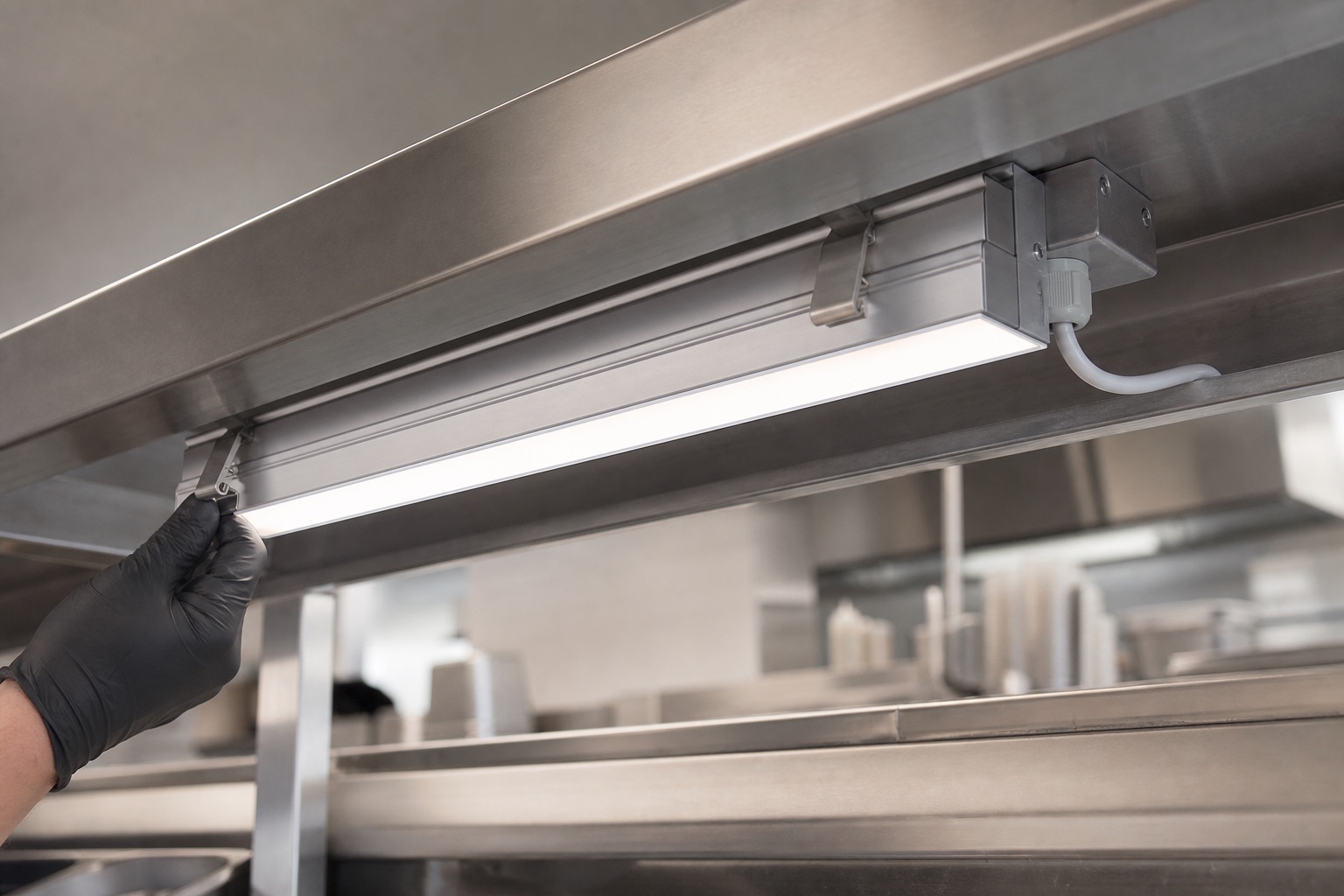
A kitchen may operate seven days a week. The best light is not the one with the most permanent sealant; it is the assembly that can be cleaned, inspected and replaced through a controlled procedure. Separate the washable outer surface from the replaceable lighting module where possible.
Before approving the metalwork, simulate removal. Confirm which fasteners release the diffuser or profile, where the disconnected module is placed, whether the cable can be isolated, and how the area is protected from contamination during service. Record the replacement strip, driver, diffuser, seal and connector as maintainable parts rather than burying them in the architectural finish schedule.
Use a Seven-State Mockup
- Task-light measurement. Measure the specified plane at the minimum, average and darkest points with the complete shelf and diffuser installed.
- Shadow review. Place hands, knives, pans and containers in normal working positions and check whether the shelf edge or worker blocks the task light.
- Glare review. Inspect direct and reflected source visibility from employee and guest viewpoints on dry and wet stainless steel.
- Food-color review. Evaluate representative ingredients and finished plates under the proposed source and dimming level, not only a color chart.
- Thermal soak. Operate nearby equipment and the final lighting scene long enough to measure profile, strip, driver and service-cavity temperatures.
- Cleaning simulation. Follow the real wipe, spray or wash procedure with the approved chemistry and inspect seals, ledges, drainage and material response.
- Service simulation. Isolate, remove, replace and restart one lighting module without exposing food, damaging metalwork or closing more equipment than planned.
Commercial Kitchen LED Strip Specification Schedule
| Field | What to record | Why it matters |
|---|---|---|
| Exact location | Pass, prep shelf, warewash edge, display, bar front, cold equipment or circulation detail. | “Commercial kitchen” is not a single exposure condition. |
| Hygiene boundary | Relation to exposed food, utensils and certified food equipment. | Determines sanitation review and whether a field-built detail is appropriate. |
| Exposure | Steam, splash, spray, grease, heat, cold, condensation and cleaning chemistry. | Drives enclosure, material, seal and location decisions. |
| Task criterion | Measurement plane, minimum and average lux, uniformity and operating scene. | Prevents reel lumens from replacing installed performance. |
| Optical detail | Strip density, profile, diffuser, setback, shield, beam and reflected-view check. | Controls shadow, glare, dots and stainless-steel reflections. |
| Color quality | CCT, CRI, TM-30 data, tolerance and representative food mockup. | Protects food appearance and visual consistency. |
| Electrical system | Voltage, watts per meter, run length, feed points, driver load, controls and listing path. | Controls voltage drop, heat and regulatory coordination. |
| Service method | Access location, isolation, fasteners, cable release, spare parts and cleaning after service. | Reduces downtime and contamination risk. |
Questions to Resolve Before Production
- Is the light external to the food equipment, or integrated into its construction?
- Can the lighting be moved outside the direct food, spray, steam or hot-air path?
- Which surfaces are wiped, sprayed or washed, and with which chemical?
- What illuminance must be achieved, and on which exact plane?
- What does the strip look like in wet stainless-steel reflections?
- Which spectral data will be reviewed for food appearance?
- Where are the driver, controller, fuse, connector and isolation point?
- Can one module be replaced without dismantling equipment or exposing food?
- Who owns sanitation, electrical and equipment-certification approval?
Specify the kitchen zone, not only the IP rating
Send the shelf drawing, equipment location, cleaning method, exposure, required lux, CCT, run lengths, voltage and service-access plan. RH Strip Lighting can help match the strip, profile, diffuser and power architecture to the real installation.
Request a Project RecommendationReferences
- U.S. Food and Drug Administration, 2022 Food Code. See Section 6-303.11 for intensity requirements at different food-service locations.
- IEC 60529, Degrees of protection provided by enclosures (IP Code). Official IEC publication page.
- NSF Food Equipment Standards. Overview of NSF/ANSI 2, NSF/ANSI 51 and related commercial food-equipment standards.
- U.S. Department of Energy, TM-30 Frequently Asked Questions. Guidance on the ANSI/IES TM-30 color-rendition system.
- UL Solutions, Lighting Safety Testing and Certification. Overview of lighting-product safety and certification services.
Request a Project or Trade Quote
Sourcing for an installation project, resale or OEM production? Share your requirements below. You can discuss project samples before committing to a bulk order.
Related Articles
LED Strip Lighting for Indoor Plant Walls: Accent Light or Grow Light?
Specify LED lighting for indoor plant walls without confusing visual brightness with plant needs. Review PPFD, DLI, controls, moisture, and…
LED Strip Lighting After a Power Outage: Designing a Reliable Restart
Plan LED strip power restoration beyond total watts. Review driver inrush, switching limits, restart scenes, and commissioning before project handover.

Why LED Strip Lights Buzz When Dimmed: A Guide for Quiet Spaces
Diagnose LED strip buzzing without guessing. Review drivers, PWM controls, mounting resonance, and low-level acoustic acceptance for quiet interiors.