
UGR and Glare Control in LED Strip Lighting: How to Specify for Visual Comfort in Commercial Spaces
The lighting specification reads “≤500 lux at desk level, 4000K, CRI 80+.” The LED strip ceiling installation goes in. The client calls two weeks later: employees are getting headaches and productivity is down. The lux target was hit. The CCT is correct. The CRI is fine. What went wrong?
Glare. Almost certainly glare. And the UGR (Unified Glare Rating) was never specified.
Glare is the single most under-specified variable in commercial LED strip lighting. It’s invisible in datasheets, absent from most supplier quotes, and rarely discussed in LED strip purchase conversations — yet it determines whether a lighting installation is comfortable and productive, or fatiguing and distracting. This guide explains what UGR means, which limits apply to which spaces, how LED strip profiles affect UGR, and what information you need from your supplier before you can verify compliance.
What Is UGR and How Is It Calculated?
The Unified Glare Rating is a mathematical formula developed by the International Commission on Illumination (CIE) and standardized in CIE 117:1995. It expresses the discomfort glare caused by a luminaire in a given room. The formula accounts for:[1]
- The luminance of the light source (how bright it appears to the eye)
- The solid angle subtended by the source at the observer’s position
- The background luminance (surrounding room brightness)
- The position index (how close the source is to the observer’s line of sight)
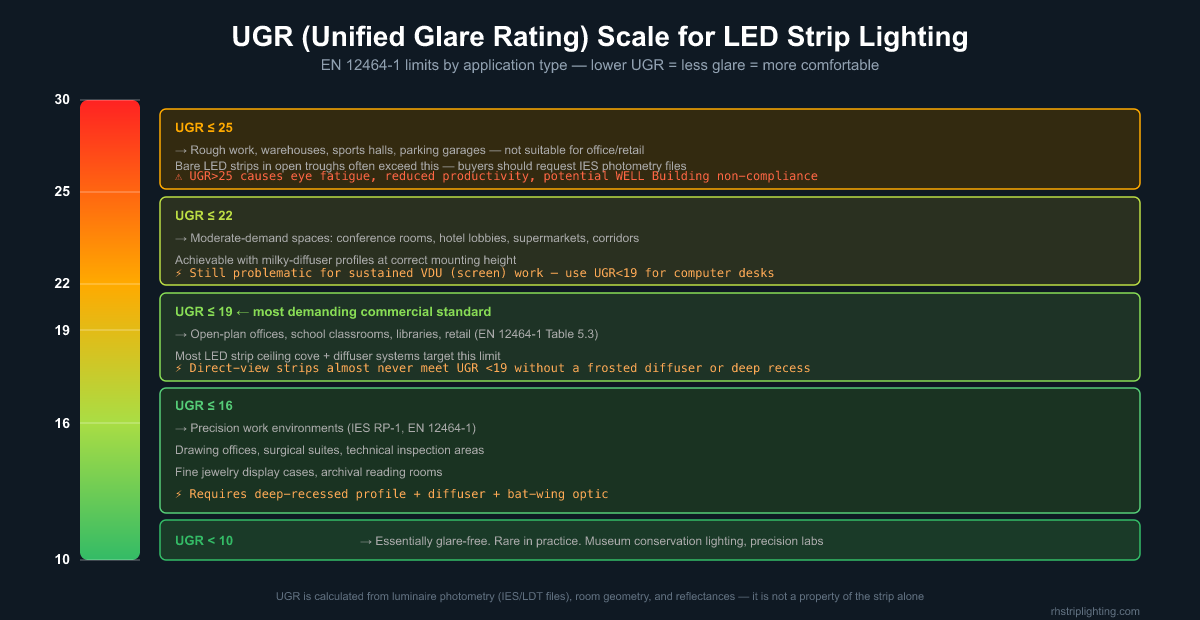
The critical point: UGR is not a property of the LED strip or luminaire alone. It is calculated for a specific room, at a specific observer position, with specific surface reflectances. The same LED strip profile in a small low-ceiling meeting room can produce a UGR of 24; installed in a tall-ceilinged open-plan office, it might give UGR 18. The number changes with the environment.
Insight: When a supplier claims “this strip has UGR <19,” they are either referring to a specific reference room scenario (often the CIE standard 4H × 8H room with 70/50/20 reflectances), or they are misusing the term. Ask for the photometric IES or LDT file and run your own DIALux simulation for your actual room dimensions. A strip that passes UGR <19 in the standard room may fail in a small office with low ceilings.
EN 12464-1 UGR Limits by Application
The European standard EN 12464-1:2021 “Light and Lighting — Lighting of Work Places” is the primary reference for UGR limits in commercial interiors. Key limits include:
| Space Type | UGR Limit | Maintained Illuminance |
|---|---|---|
| Drawing / drafting offices | ≤16 | 750 lux |
| Offices (VDU use, screen work) | ≤19 | 500 lux |
| School classrooms | ≤19 | 300 lux |
| Libraries, reading rooms | ≤19 | 500 lux |
| Retail, general sales area | ≤22 | 300 lux |
| Hotel lobbies, reception | ≤22 | 200 lux |
| Conference rooms | ≤19 | 500 lux |
| Warehouses, rough work | ≤25 | 200 lux |
In North America, IESNA RP-1-12 (offices) specifies a maximum luminance of 850 cd/m² in the 45–85° zone from nadir — a different metric but with similar intent. The WELL Building Standard v2 (Feature L06) restricts luminaire luminance to ≤2500 cd/m² at 45° and above for spaces with screens.[2]
Why Bare LED Strips Almost Always Fail UGR Limits
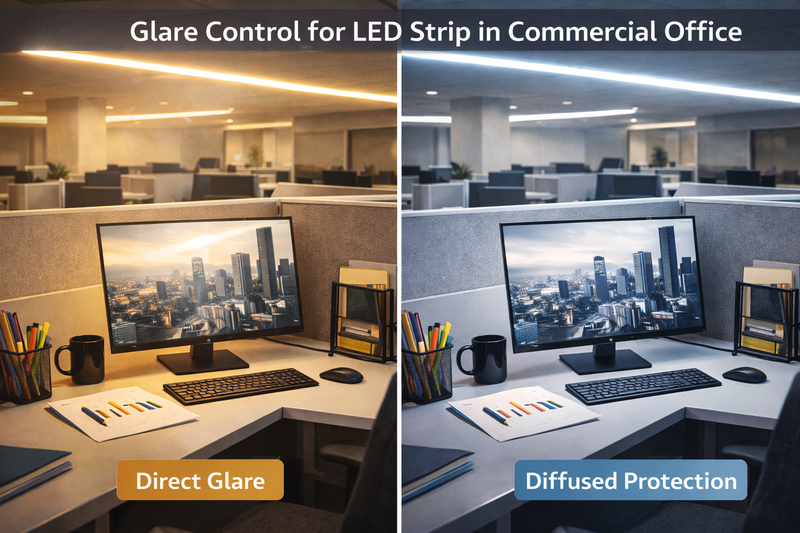
A bare LED chip on a PCB strip has a surface luminance of 1–4 million cd/m² — orders of magnitude above the human comfort threshold. Even at low power, the intense point source of each LED chip in the field of view causes discomfort glare. In a typical office space with a bare strip run at 2.8m mounting height:
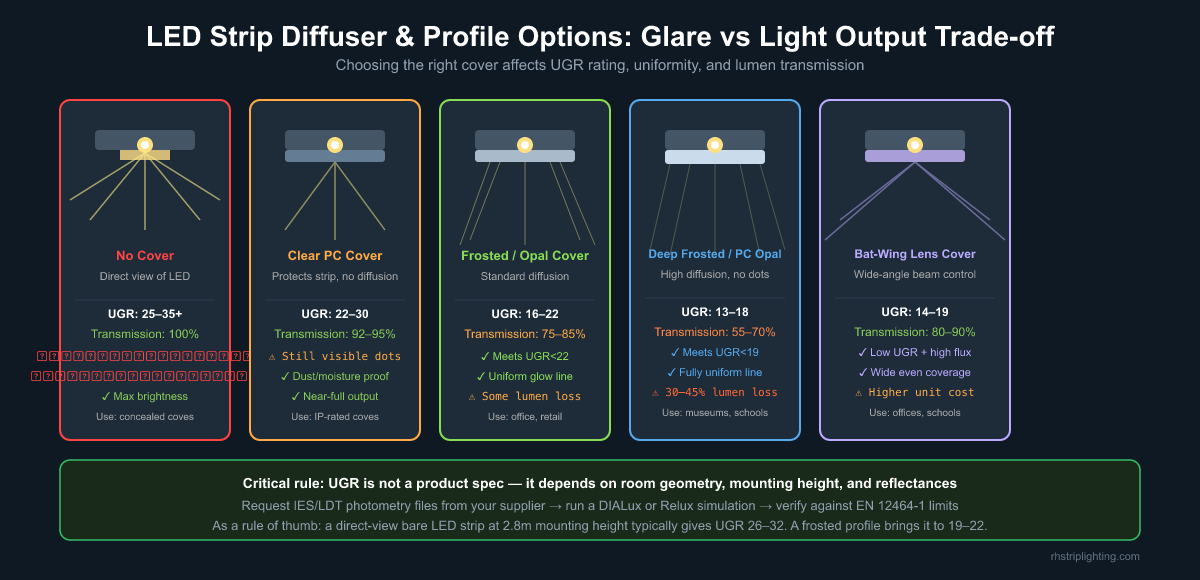
- Bare strip (no cover): UGR typically 26–35
- Clear PC cover: UGR typically 22–30 (individual chips still visible)
- Frosted/opal PC cover: UGR typically 16–22
- Deep frosted or sandblasted cover: UGR typically 13–19
- Bat-wing optic lens: UGR typically 14–19 with 80–90% light transmission
The implication is clear: no bare LED strip installation in an office, school, or retail space should be considered UGR-compliant without photometric verification. The frosted aluminum profile is not an optional aesthetic choice — it is a functional specification requirement.
Profile Selection for UGR Compliance
The aluminum profile serves three functions simultaneously: heat dissipation, mechanical protection, and optical control. For UGR compliance, the optical function matters most. Profile geometry affects glare in three ways:
1. Aperture angle restriction: A surface-mounted profile with a 120° beam angle exposes the strip to wide-angle viewing. A recessed profile with a 60° aperture limits visibility to occupants sitting far to the side, reducing the position-index contribution to UGR.
2. Diffuser transmittance: A frosted PC cover reduces luminance by spreading the light over a larger apparent area. A milky opal cover with 70% transmittance reduces luminance by approximately 30% compared to the bare source while also reducing output by 30%. The relationship is roughly proportional — higher diffusion = lower UGR, but also lower efficiency.
3. Recessing depth: Strips mounted in deep recessed channels (flush with ceiling or wall) are shielded at angles above 45°, dramatically reducing glare for observers with typical downward gaze angles. This is why architectural cove lighting — where the strip is completely hidden and only the reflected light is visible — essentially eliminates UGR concerns entirely.
Retail: The UGR Exception Space
Retail environments present a unique UGR calculus. The standard (EN 12464-1, UGR ≤22 for general sales areas) is less stringent than offices — but more importantly, high-intensity accent lighting, sparkle, and visual punch are desirable in jewelry, cosmetics, and premium goods retail. The industry practice is to use:
- High-UGR track spotlights for merchandise accent (deliberately punchy)
- Low-UGR linear LED strip (with diffusers) for ambient/ceiling fill lighting
- Separate UGR analysis for checkout zones and back-of-house areas
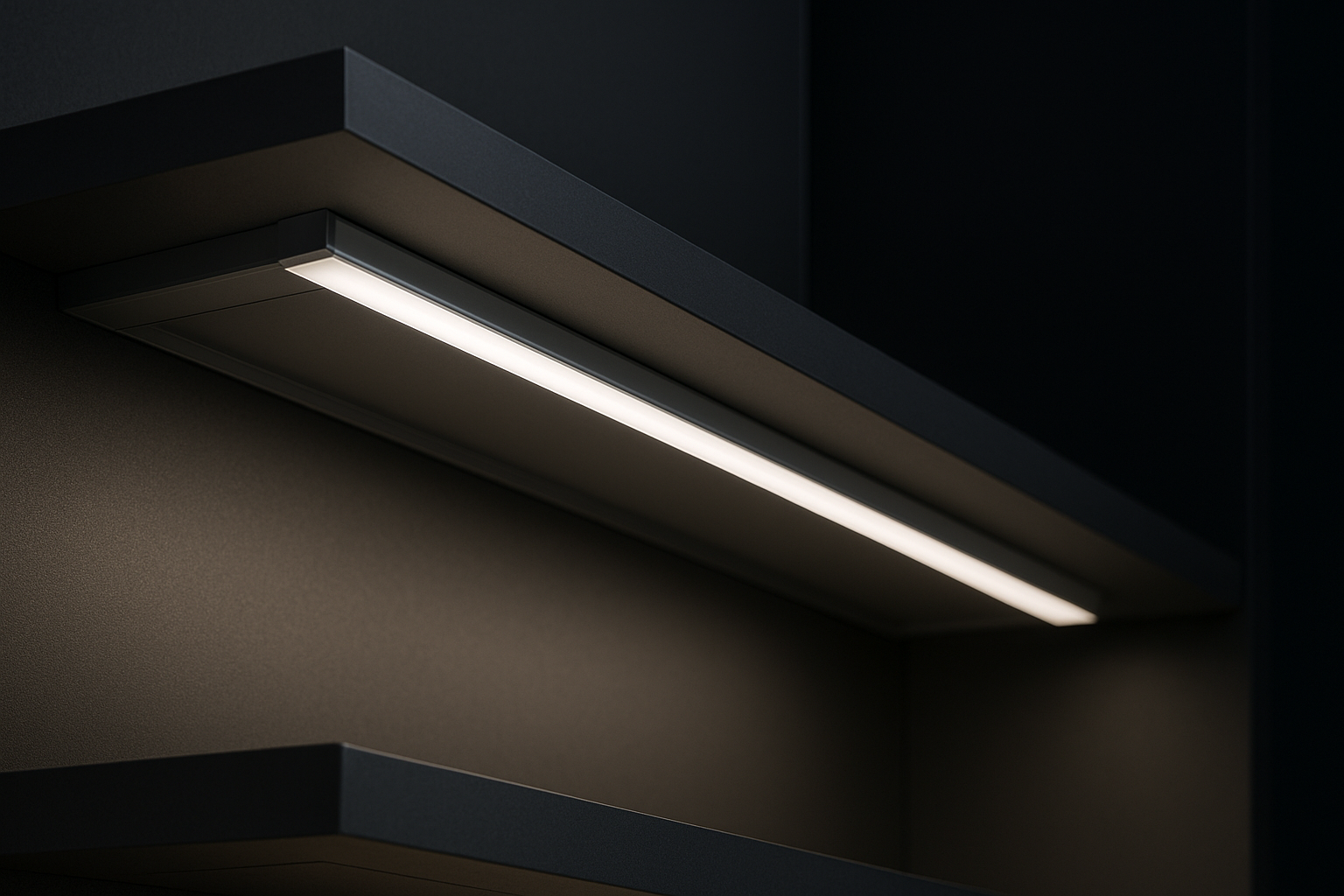
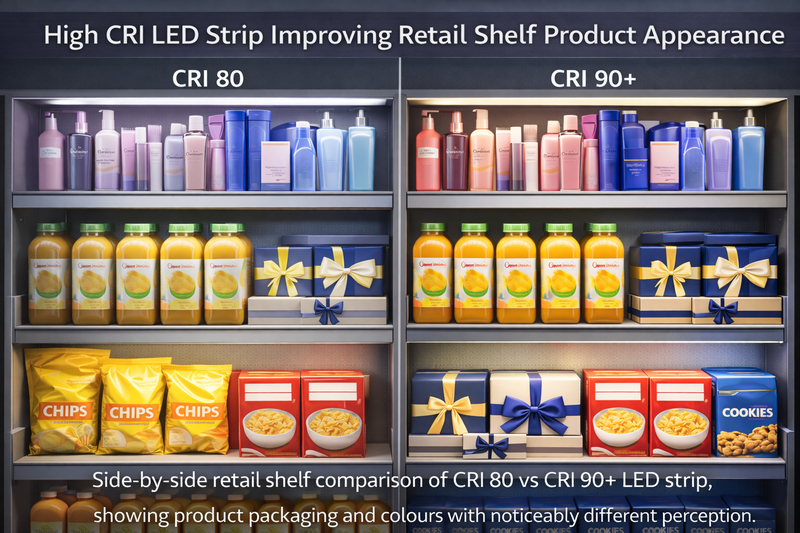
For shelf-level LED strips used in under-shelf display lighting, UGR is rarely an issue — the observer is not looking at the strip from below. However, shelf strip selection should prioritize CRI ≥95 and R9 ≥80 for accurate merchandise color rendering, which matters far more than UGR in that context.
Staircase and Corridor Applications
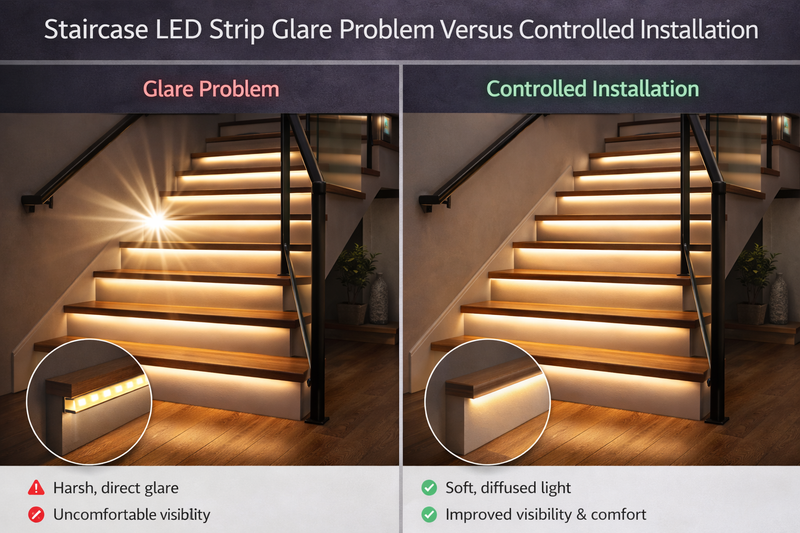
LED strips in staircases and corridors create a specific UGR hazard: the observer is often looking upward at an angle, and the strip may be in the lateral field of view for extended periods of walking. Poorly specified staircase lighting with bare strips at eye-level creates significant discomfort and potential safety risks if glare reduces step-edge visibility.[3]
Best practice for staircase LED strip installations:
- Mount strips below the nosing (underside of tread overhang) — strip is never in the upward field of view
- Or recess strips into the wall, directed horizontally across the tread surface
- If ceiling-mounted, use a deep recessed aluminum profile with frosted cover
- Limit maximum strip luminance to ≤1500 cd/m² at any viewing angle for safety-critical staircase zones
How to Verify UGR Compliance Before Purchasing
The correct workflow for UGR-compliant LED strip specification is:
- Request the IES or LDT photometry file from your strip+profile supplier. This is the luminous intensity distribution file for the complete assembly (strip + profile + diffuser). Do not accept marketing claims — only measured photometry files are valid inputs for calculation.
- Run a simulation in DIALux evo, Relux, or AGi32 using your actual room dimensions, reflectances, and occupant positions. Place the luminaire photometry file and calculate UGR at the specified positions.
- Compare against the applicable standard (EN 12464-1 or IESNA RP-1). If the simulation fails, consider: deeper profile recess, higher-transmission diffuser (if target lux is also failing), wider spacing, or lower mounting height.
- Document the simulation in the project O&M file. If the client later modifies the space (lowers ceiling, adds partitions), the UGR compliance needs to be re-verified.
Frequently Asked Questions
Is UGR the same as glare index?
UGR (Unified Glare Rating) is one of several glare metrics. Others include the Daylight Glare Index (DGI), the Visual Comfort Probability (VCP) system used in North America, and the simplified Glare Rating (GR) for outdoor areas. For indoor commercial lighting, UGR per CIE 117 and EN 12464-1 is the most widely used international standard.
Can a supplier guarantee UGR ≤19 for my specific project?
No supplier can guarantee a UGR value for a specific project without knowing your room geometry. What a good supplier can provide is the IES/LDT photometry file for their strip-and-profile assembly, from which you can calculate UGR for your room. A supplier who quotes a single UGR number without this context is giving you a reference-room result, not a project-specific guarantee.
Does recessing the LED strip always reduce UGR?
Recessing increases shielding angle and typically reduces UGR, but it also changes the beam distribution and may reduce floor illuminance. Deep recessing without a diffuser may create high-contrast luminance ratios between the strip aperture and the surrounding ceiling, which is uncomfortable in a different way. The optimal balance is usually a frosted diffuser in a moderate-depth recess.
What does “low-glare” or “anti-glare” mean on LED strip packaging?
These terms have no standardized meaning and should not be relied upon without photometric data. “Anti-glare” usually refers to a frosted cover, which reduces perceived sparkle but does not guarantee EN 12464-1 compliance. Always request the UGR calculation for the specific room scenario.
Should I worry about reflected glare from LED strip light on computer screens?
Yes. Reflected glare (sometimes called veiling reflections) occurs when the light source reflects off a computer screen into the observer’s eyes. This is partly controlled by UGR, but also depends on screen tilt angle and the strip’s position relative to the screen. The WELL v2 luminance limit of ≤2500 cd/m² at 45° addresses this. Avoid mounting strips directly in front of seated VDU users where specular reflection geometry is unfavorable.
Recommended Products
- Single Color SMD LED Strip Light — 4000K/5000K, CRI 90+, for office, school, and retail ambient lighting
- Single Color COB LED Strip Light — continuous dot-free line, ideal for cove and linear profile installs
- Tunable White SMD LED Strip Light — 2700K–6500K, for WELL-compliant dynamic CCT applications
Footnotes
- CIE 117:1995 “Discomfort Glare in Interior Lighting” defines the UGR formula and the standard reference room conditions (4H × 8H room, 70/50/20 reflectances). Available via CIE Publications
- WELL Building Standard v2, Feature L06 “Visual Lighting Design” — specifies luminance and UGR limits for VDU-intensive workspaces. Published by the International WELL Building Institute: WELL v2 L06
- IES (Illuminating Engineering Society) “The Lighting Handbook, 10th Edition” Chapter 24 covers staircase and egress lighting requirements including glare and step-edge visibility criteria. IES Handbook
Request a Project or Trade Quote
Sourcing for an installation project, resale or OEM production? Share your requirements below. You can discuss project samples before committing to a bulk order.
Related Articles
LED Strip Lighting for Indoor Plant Walls: Accent Light or Grow Light?
Specify LED lighting for indoor plant walls without confusing visual brightness with plant needs. Review PPFD, DLI, controls, moisture, and…
LED Strip Lighting After a Power Outage: Designing a Reliable Restart
Plan LED strip power restoration beyond total watts. Review driver inrush, switching limits, restart scenes, and commissioning before project handover.
Why LED Strip Lights Buzz When Dimmed: A Guide for Quiet Spaces
Diagnose LED strip buzzing without guessing. Review drivers, PWM controls, mounting resonance, and low-level acoustic acceptance for quiet interiors.