
LED Strip Lighting for Wine Cellars and Bottle Displays: Beyond Warm White
A restaurant wine wall has two jobs: help guests choose a bottle and hold saleable stock. Lighting can improve the first while quietly undermining the second. The conflict is especially easy to miss when a warm-white LED strip produces little obvious radiant heat and makes every bottle look attractive.
The correct question is not simply “Which color temperature looks expensive?” It is “How can we make the labels readable while limiting unnecessary exposure of the wine?” That changes the specification from a roll of tape with a kelvin number into a coordinated decision about spectrum, optics, operating hours, packaging, and stock movement.
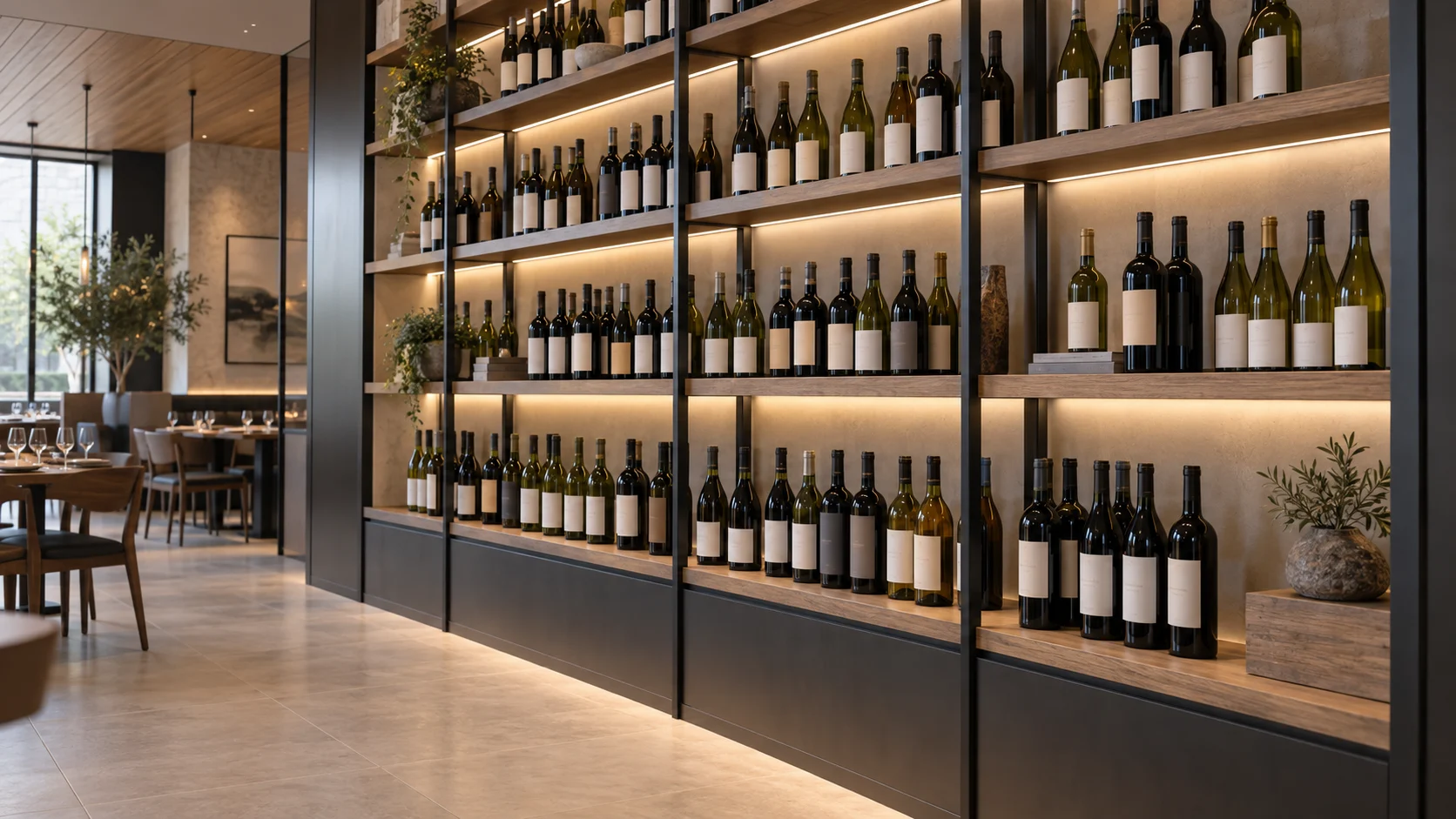
This guide is for hospitality designers, joinery manufacturers, lighting contractors, and wine-display buyers. It is not a wine shelf-life prediction or a complete cellar climate specification. The wine producer or a qualified wine specialist should set product-handling requirements; the lighting designer should document how the proposed installation addresses them.
1. Understand Why LED Does Not Automatically Mean Wine-Safe
Light-struck taste is a wine-quality fault associated with photochemical reactions, including pathways involving riboflavin and sulfur-containing compounds. Relevant exposure can include short-wavelength visible light, not just UV. Research on white and rosé wines has examined LED spectrum as a way to reduce degradation, including reducing output in the 400–450 nm region.[1]
That same study reported relatively small degradative effects from its tested LED treatments compared with UV exposure. The useful conclusion is that source selection matters, not that all LEDs are damaging or that every commercial LED is protective. Different wines, source spectra, doses, and test conditions prevent a universal safe-time claim.
Ask a supplier what “wine-safe” means and what evidence supports it. A UV statement without its wavelength range and test conditions leaves an important question unanswered. Likewise, an LED strip that feels cooler than an older lamp may still emit wavelengths relevant to photochemical change.
Do not transfer results from a specialist spectrum to an ordinary tape light based on a similar product photograph. If preservation is a material project requirement, the purchasing specification needs product-specific spectral information and an agreed validation method, not only a marketing label.
2. Start With the Bottles and Their Time on Display
Request a simple inventory profile before choosing the light. Record bottle colors, wine categories, typical and longest display periods, shelf positions, daylight exposure, and whether the visible bottles will be sold or are display-only props. A mixed wine wall should not be specified around its least sensitive stock.
A 2020 supermarket-condition study of white wines found earlier light-strike problems in some flint-glass bottles, while green bottles provided better protection during the tested period. Fault onset varied across wines, and moving previously exposed bottles into dark, cold storage did not remove the fault.[2] Those observations support exposure management; they do not establish a safe number of retail days for a different installation.
| Display situation | Design priority | Operational decision |
|---|---|---|
| Clear-glass white or rosé wine | Review spectral exposure and avoid unnecessary illumination through the bottle. | Agree display duration and protected reserve storage with the wine supplier. |
| Mixed green, amber, and clear bottles | Assess representative packaging rather than treating bottle color as a certificate. | Identify which stock can occupy each display position. |
| Slow-moving premium inventory | Separate merchandising from long-term holding. | Consider display-only bottles or a limited display quantity where suitable. |
| Fast-turnover restaurant selection | Make labels readable at the lowest practical exposure. | Track actual dwell time; do not assume every bottle sells quickly. |
| Window-facing wine wall | Assess daylight before fine-tuning the electric lighting. | Review shading, placement, and the glazing system. |
A separate bottle-transmission study found that glass color, bottle shape, labels, and illumination geometry all affected how much light entered the bottle.[3] This is a reason to test real packaging. It is not a reason to assume a large paper label or any green glass provides complete protection.
3. Choose a Spectrum, Not Just a Kelvin Number
CCT describes the apparent color of a light source; it compresses a complex spectral power distribution into one descriptor. The U.S. Department of Energy explains that sources with the same CCT can still differ in appearance and spectral characteristics.[4] A 2700K or 3000K selection is therefore an aesthetic starting point, not a wine-preservation specification.
Request the measured spectral power distribution, or SPD, for the exact LED variant and operating condition. If an optical cover or filter is claimed to reduce particular wavelengths, request its transmission data and information for the finished assembly. A decorative amber cover is not equivalent to a documented spectral filter.
Distinguish a normalized spectrum from an exposure measurement. A graph scaled so its highest peak equals one can reveal spectral shape, but it does not show the absolute radiation reaching a bottle. A preservation assessment may need spectral irradiance at the bottle position, measured by a competent specialist, together with packaging transmission and operating duration.
Use high color-rendering performance to support label and interior appearance, not as proof of protection. Amber or spectrally restricted light may change how labels and finishes look. Compare actual labels under a sample before accepting that tradeoff. RH’s CRI guide and commercial color-temperature guide cover visual selection separately.
For tunable-white or RGBW systems, review every permitted operating scene. One carefully assessed preset does not validate a brighter or bluer preset selected later. Define which scenes staff can access and which settings remain part of commissioning.
4. Light the Label Before Lighting the Liquid
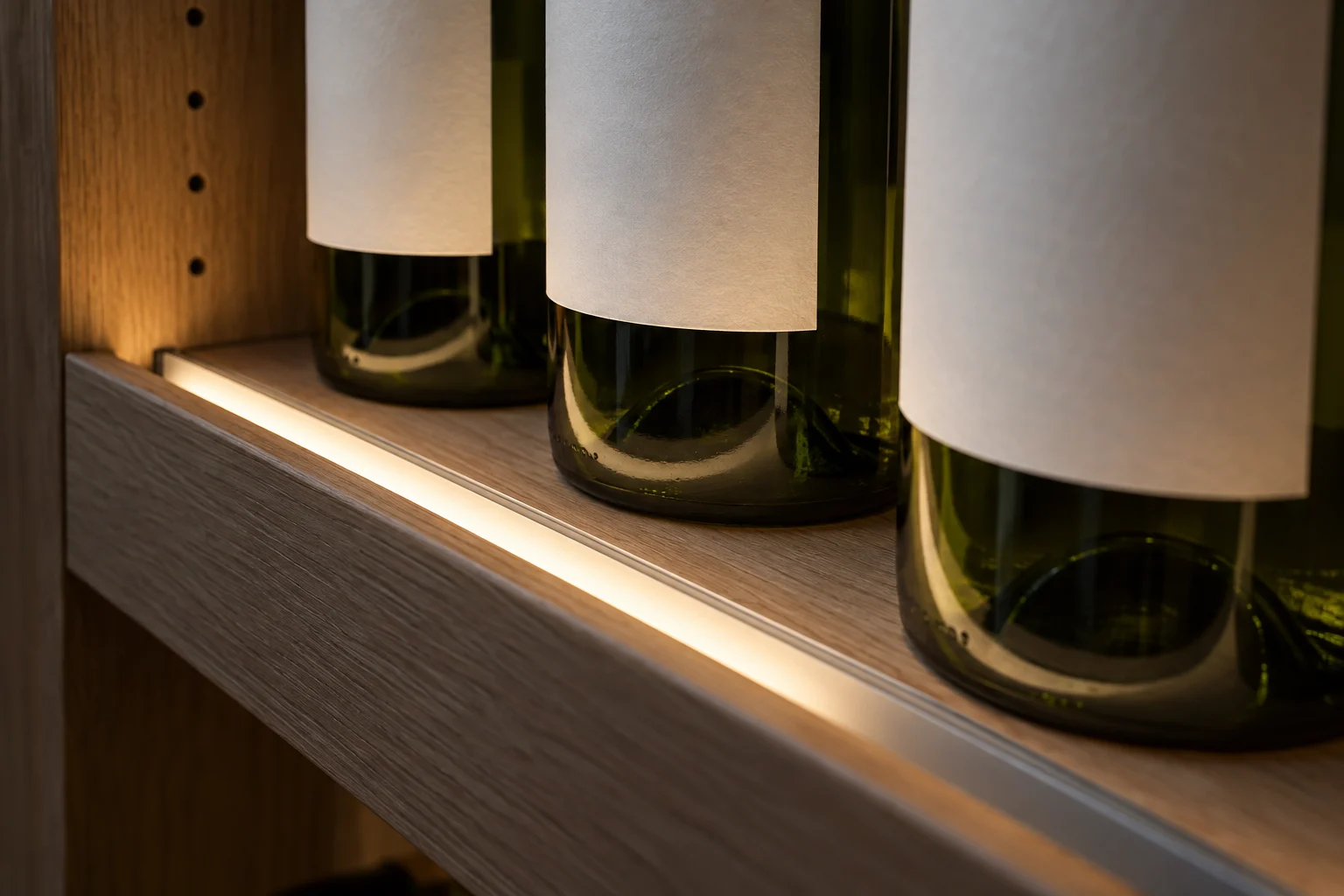
Use the label plane as the first visual target. Trial a concealed front-edge or side-mounted profile with an appropriate optical direction before committing to a luminous back panel behind the bottles. The objective is readable information without using the wine itself as a glowing decorative object.
This is a layout strategy, not a quantified protection guarantee. Light still reaches the bottle by direct paths and reflections. Compare the actual candidate positions with the same bottle arrangement, output setting, and room lighting. Record label visibility and exposure measurements separately.
Inspect from seated guest positions, the aisle, and the staff retrieval position. A continuous COB source can remove visible LED dots yet still appear as a harsh line in glossy glass. Shielding, source luminance, profile orientation, and the viewing angle remain important. See the glare-control guide for that distinction.
Test a partially empty shelf as well as a full one. Removing a front row can expose rear bottles or reveal a light source previously hidden from view. Do not depend on one merchandising arrangement to provide permanent shielding. For general shelf geometry, use RH’s retail shelf-lighting guide, then add the wine-specific exposure review.
5. Make Operating Hours Part of the Specification
Lighting schedules are often cheaper to improve than joinery. Separate decorative display lighting from circulation and required safety lighting. Let staff retrieve stock safely without leaving every bottle illuminated throughout cleaning, preparation, and overnight periods.
For operational comparisons, record illuminance at a repeatable bottle position and multiply it by the hours of exposure. Lux is weighted for human visual response, not for a wine’s photochemical sensitivity. CIE guidance explicitly distinguishes photometric quantities from photochemical and photobiological quantities.[5] Lux-hours are useful for tracking a consistent installation, but equal lux-hours from different spectra do not imply equal wine effects.
Illustrative schedule: at one measurement point, 180 lx for 14 hours gives 2,520 lx·h per day. Reducing the same installation to a measured 120 lx for 14 hours gives 1,680 lx·h. Operating that 120 lx scene for five hours gives 600 lx·h, approximately 76% below the original total.
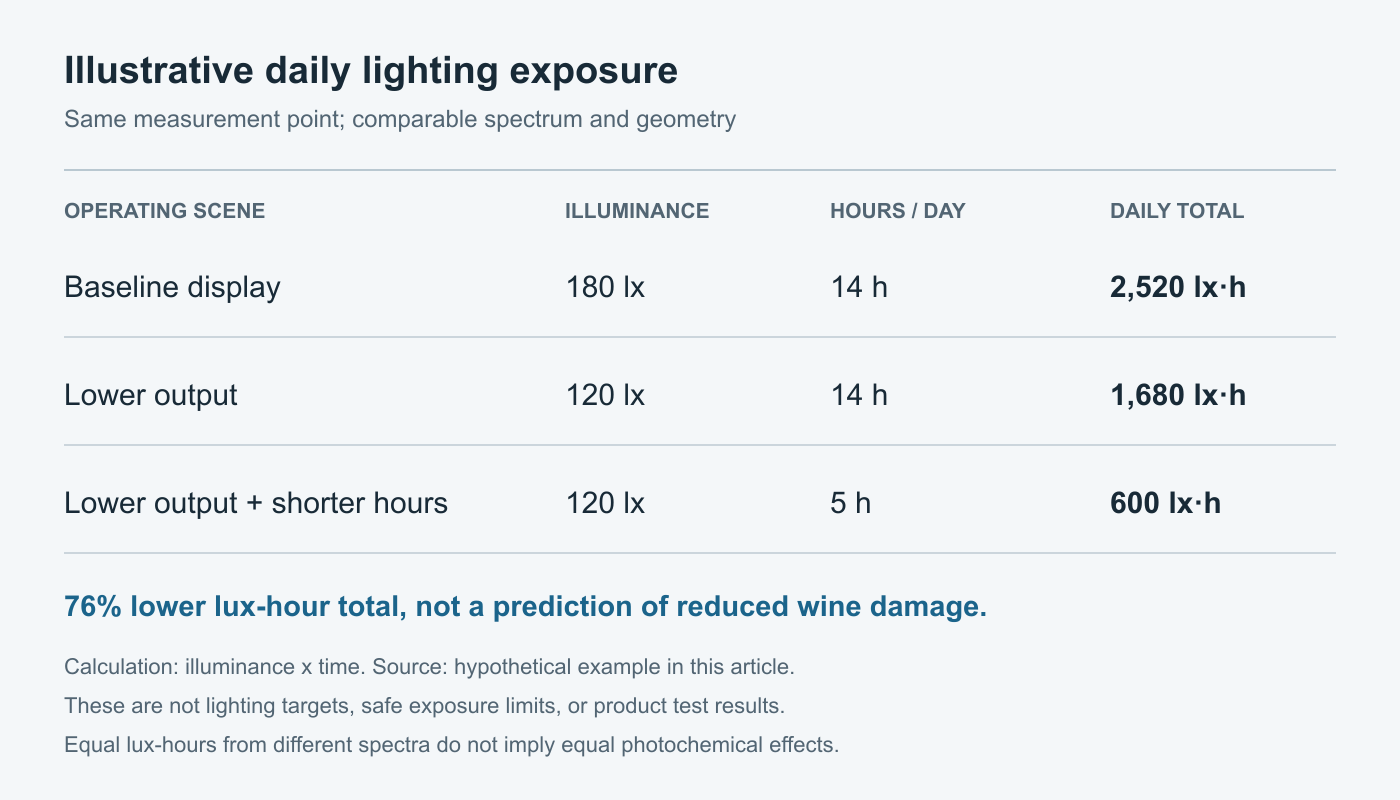
The calculation does not predict 76% less chemical damage or four times the shelf life. It only quantifies the change in this visual exposure proxy. Check whether dimming changes the spectrum, include other light sources, and keep the measurement orientation consistent.
Choose controls for the operating pattern: a closing-time schedule for a restaurant display, a door contact for an enclosed cabinet, or occupancy control for an infrequently entered storage area. Check false triggering, override timeouts, and behavior after a power interruption. A switch left in permanent override defeats the intended schedule. RH’s dimming-method guide helps compare control arrangements.
6. Keep Heat and Condensation as Separate Checks
LED efficiency does not eliminate heat. ENERGY STAR identifies thermal management as a key factor in LED performance and longevity.[6] In a cabinet, also assess the effect of the installed lights on the intended storage conditions instead of relying on a hand-touch test.
For a hypothetical eight-meter installation rated at 6 W/m, the strip load is 48W before upstream losses. That is an electrical load figure, not a prediction of bottle temperature or cooling capacity. The enclosure, ventilation, radiant paths, operating hours, driver location, and refrigeration system determine the thermal outcome.
Use the specified mounting profile and thermal interface. Maintain the required spacing and ventilation around the driver, keep it accessible, and avoid obstructing the cabinet’s airflow. Review profile design with the aluminum-profile guide; calculate supply capacity using the power-supply sizing guide.
Where the wine display is cooled, assess humidity, condensation at openings, cleaning, connections, and penetrations with the cabinet supplier. A strip-body IP rating does not automatically cover field joints or the enclosure. Do not drill through a refrigerated cabinet or vapor-control layer without the equipment supplier’s approval. RH’s refrigerated display-lighting guide addresses those environmental interfaces.
7. Separate Display Stock From Reserve Stock
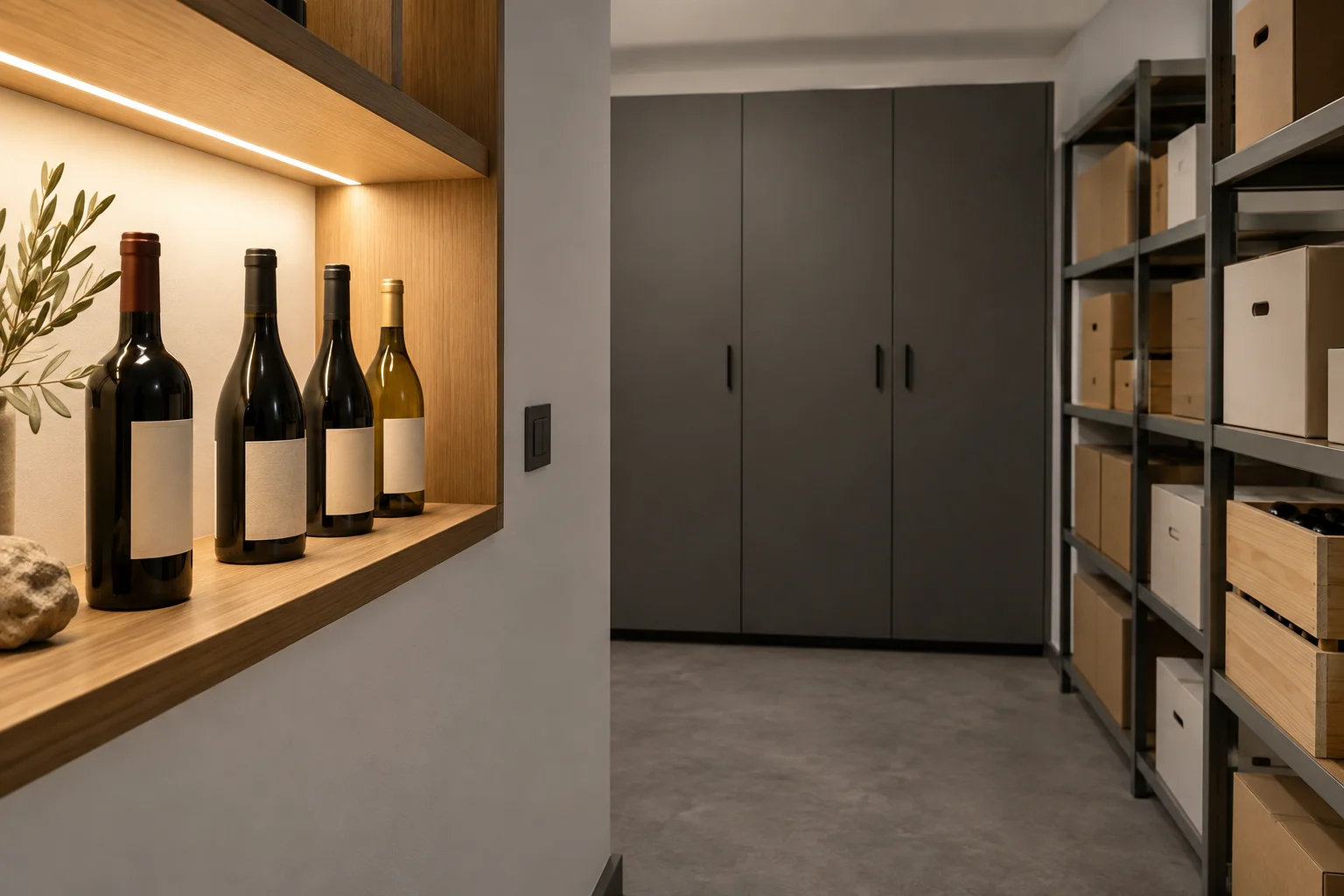
A useful business decision may be to display fewer saleable bottles rather than buy more lighting. Keep reserve inventory in suitable protected storage, and replenish the display according to an agreed stock policy. Where operationally appropriate, clearly controlled display-only bottles can provide the visual effect without exposing the saleable contents.
Rotation distributes exposure; it does not reverse exposure already received. Do not repeatedly move the same slow-selling bottle between a lit display and reserve storage while resetting its display-age record. Record entry dates or cumulative display periods for stock where the wine supplier considers that necessary.
Protect the design from later merchandising changes. A manager may add clear-glass rosé bottles to a shelf originally reviewed with dark packaging, or extend opening hours without revisiting lighting. Include those changes in the handover checklist. An approved lighting scene is only one part of the operating arrangement.
Consider daylight separately. Switching off the LED strips does not remove exposure from a nearby window. Request glazing or film transmission information when light filtering is part of the design; a generic UV-filtering claim does not establish control of every relevant visible wavelength.
8. Approve a Working Sample, Not a Rendering
Build a representative shelf with the proposed light, profile, cover, driver, control, finishes, and real bottle packaging. Include the least favorable viewing position and the stock type requiring the most careful review. A rendering can establish appearance, but it cannot validate spectrum, temperature, or exposure.
| Approval item | Record before ordering | Do not accept as a substitute |
|---|---|---|
| Visual result | Readable labels, acceptable reflections, and full/partly empty shelf checks. | A photograph of a bare strip or one ideal viewing angle. |
| Spectrum | Exact variant SPD, operating scene, and any filter data; specialist exposure review where required. | Only CCT, CRI, or an undefined “no UV” claim. |
| Operating duration | Normal schedule, cleaning scene, override timeout, and restart behavior. | An instruction to “remember to turn it off.” |
| Stock handling | Bottle types, display duration policy, reserve storage, and responsibility for changes. | An assumption that all bottles turn over quickly. |
| Thermal and moisture conditions | Assessment under representative operation and agreed cabinet-interface details. | A cool-touch impression or strip-body IP rating alone. |
| Maintenance | Approved replacement components and a process for checking substituted LED variants. | A replacement that merely matches voltage and warm-white appearance. |
Agree the wine-quality validation with the producer or a competent laboratory where the project requires evidence of preservation. Do not invent a universal lux limit or extrapolate a published experiment into a guarantee for unrelated wine and packaging. The practical aim is an auditable specification with clear limitations.
Choosing an RH Lighting Option
COB and SMD describe light-source construction, not wine-protection performance. Use them to compare physical fit, visible dot control, output, and serviceability. Then request the exact variant’s data and assess it for the intended application. This article does not claim that ordinary RH LED strips have been validated to prevent light-struck taste.
Build a readable display without unnecessary bottle exposure
Share your wine-wall layout, stock profile, desired appearance, cabinet conditions, and control schedule with RH Strip Lighting. Ask for available model-specific data and a sample for review. Where specialized spectral performance or preservation evidence is required, establish that capability before confirming the order.
Request a Wine-Display Lighting ReviewThe strongest design does not make every bottle the brightest object in the room. It makes selection easy, limits avoidable exposure, and gives staff a system they can operate consistently. Specify those outcomes together, and warm-white appearance becomes one informed choice rather than the entire specification.
References
- Influence of different types of LEDs lights on the formation of volatile sulfur compounds in white and rosé wines. Food Chemistry, 371 (2022), 131144. Product- and experiment-specific findings, not approval of generic LED strips.
- White wine light-strike fault: A comparison between flint and green glass bottles under the typical supermarket conditions. Food Packaging and Shelf Life, 24 (2020), 100492.
- In situ measurement of light transmission into wine bottles and calculation of shelf life. OENO One, 57(1), 2023. Bottle-transmission and modelling study; no shelf-life prediction from it is applied to RH products.
- U.S. Department of Energy: LED Color Characteristics. Explanation of CCT and the information it does and does not convey.
- CIE TN 002:2014: Relating Photochemical and Photobiological Quantities to Photometric Quantities. Basis for distinguishing visual measurements from spectrally weighted effects.
- ENERGY STAR: Learn About LED Lighting. General LED thermal-management guidance, not a wine-storage standard.
Request a Project or Trade Quote
Sourcing for an installation project, resale or OEM production? Share your requirements below. You can discuss project samples before committing to a bulk order.
Related Articles
LED Strip Lighting After a Power Outage: Designing a Reliable Restart
Plan LED strip power restoration beyond total watts. Review driver inrush, switching limits, restart scenes, and commissioning before project handover.
Why LED Strip Lights Buzz When Dimmed: A Guide for Quiet Spaces
Diagnose LED strip buzzing without guessing. Review drivers, PWM controls, mounting resonance, and low-level acoustic acceptance for quiet interiors.
LED Strip Lighting for Modular Retail Shelves: Design for Reconfiguration
Specify modular shelf lighting beyond driver wattage. Check shared-feed current, connector durability, cable movement, controls, and approved configurations.